Weekly FDA Roundup: Amazon and Walmart warned over herpes remedies shipped from their warehouses, and FDA drafts a traceability reprieve for mid-size restaurants, October 3–9, 2026
FDA bought herpes remedies on Amazon and Walmart.com, then warned both platforms and eight sellers. Plus a traceability reprieve for mid-size restaurants and one bad broccoli seed lot.
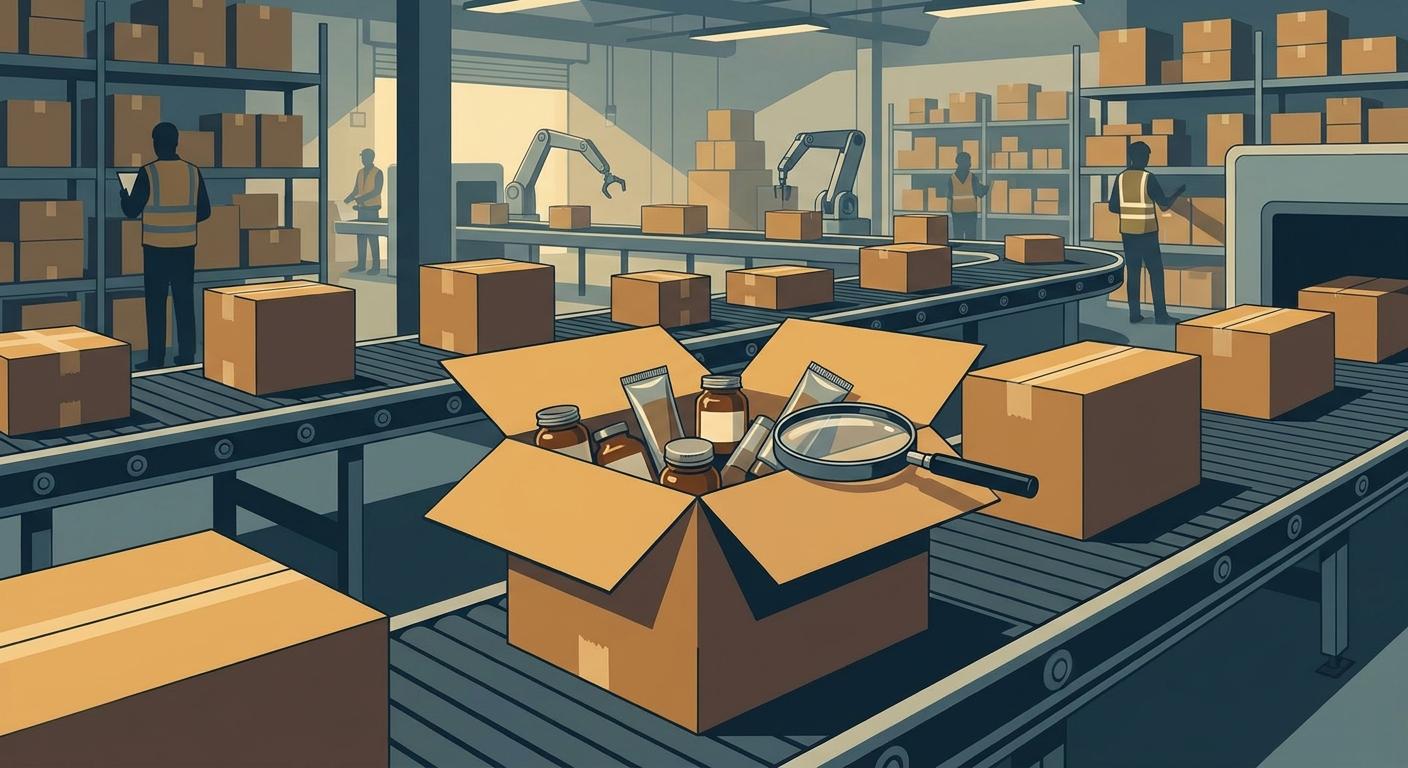
On October 6 FDA posted ten warning letters from a single sweep. All ten are dated October 1, and all ten concern products sold to treat or relieve genital herpes and other sexually transmitted infections. Two went to Amazon and Walmart, because FDA bought the products on their websites and the platforms' own fulfillment services shipped them. The same week, FDA released a draft guidance that would stop enforcing the food traceability rule against restaurants and food retailers with annual food sales between $250,000 and $1 million.
By the numbers
- 71 FDA actions posted October 3 to 9: 23 recalls, 19 warning letters, 16 Federal Register notices, 7 device rules, 3 device safety alerts, plus the traceability draft guidance and an ibogaine announcement.
- 10 of the 19 warning letters targeted STI products, and FDA says it has approved no over-the-counter drug for any STI.
- 8 Class I entries in the October 7 enforcement report. Six are Todd's Seeds sprouting seed products that share one reported quantity, 37,481 retail units.
- 1 bulk broccoli seed lot, W4105, behind recalls by three online seed sellers in seven days.
- Standout: Philips reported 8 serious injuries and 4 deaths tied to its Lumify handheld ultrasound refusing to scan without a network connection.
Lead story: FDA holds Amazon and Walmart responsible for what their warehouses ship
FDA's drug center reviewed the products in July 2026. For the two retailers it went further and bought them. The Amazon letter, addressed to CEO Andy Jassy, names nine products, including FemiClear, HClear for him, HerpCare Ointment and Spray, Herstat GST, RoyceDerm Herpes Relief Cream, and Terragen HG Formula. Each was "fulfilled" by Amazon, and the letter quotes Amazon's own description of FBA: "we'll pick, pack, and ship orders." That is the hook. Amazon did not make these creams, but it introduced them into interstate commerce. The Walmart letter makes the same case for three products shipped through Walmart Fulfillment Services.
The other eight letters went to the brand owners: OrganiCare (FemiClear, HClear), Terramed (HerpCare), Bioactive Services/Herstat, RoyceDerm, Aidance Scientific (Terragen), Graceful Touch ("Herpes B Gone"), and two homeopathic sellers. DesBio sold "CHLA:10M," made from Chlamydia trachomatis, and The Platinum Healthcare sold "Sycosis" and "Syphillinum."
Two legal details in these letters will outlast this sweep. First, the homeopathic label did not help. Several products contain lemongrass, which is not listed in the Homeopathic Pharmacopeia, so FDA says they fall outside its 2022 homeopathic enforcement guidance, and would be priority targets under it anyway. Second, Herstat GST tried to fit OTC Monograph M017 for external analgesics. FDA's answer is that M017 covers pain, itching, and minor skin irritation, and "genital sore treatment" goes beyond it.
If you sell topical OTC or homeopathic products, read your listing copy the way FDA did. Claims like ">90% of users reported less severe outbreaks" or "reduces recurrence" make a product a new drug. If you sell through FBA or Walmart Fulfillment Services, our expectation is that the platforms pull listings quickly once they get a letter like this, so the platform may act before you can respond. Responses to FDA are due 15 business days after receipt.
Key developments
A traceability reprieve for mid-size restaurants and retailers
The food traceability rule already exempts retail food establishments and restaurants averaging $250,000 or less in annual food sales. A draft guidance published October 9 says FDA intends to use enforcement discretion for every requirement of the rule for those between $250,000 and $1 million, adjusted for inflation from 2020. It is a draft, and comments close November 23. FDA also scheduled a virtual public meeting on lot-level traceability for November 6. The notice confirms that Congress directed FDA not to enforce the rule before July 20, 2028. If you supply restaurants, note that the reprieve covers the restaurant or store, not its suppliers.
One broccoli seed lot, three online sellers
Eden Brothers (October 7) and Gardeners Basics (October 8) recalled broccoli seeds after their supplier recalled bulk lot W4105, where FDA sampling found Salmonella. Gardeners Basics says the seeds were also used by a sprout grower whose sprouts were part of an FDA multistate outbreak investigation. EAK Distribution recalled the same lot on October 2. All three sold on Amazon, and Gardeners Basics also sold through Walmart, TikTok Shop, eBay, and Etsy. Separately, Todd's Seeds' six Class I entries trace to alfalfa seed its supplier recalled for possible E. coli and Salmonella. Home sprouting kits are a food business. Ask your seed supplier for lot-level pathogen results.
Philips Lumify needs Wi-Fi to work
FDA's Early Alert says a software bug makes the Lumify app forget a registered transducer and demand re-registration, which requires Wi-Fi or cellular signal. In ambulances and aircraft that can mean no scan at all. Until Philips ships a fix, it says to use Lumify only where a signal is available or a backup is on hand. Separately, FDA updated BD's Class I recall of Alaris pump infusion sets on October 5, after BD found some sets perform worse than it had disclosed, mostly at rates under 1 mL/h. That matters most for neonates and critically ill patients.
Supplements: DMAA, and alcohol in gripe water
Leader Formulas recalled one lot of RAPTURE Preworkout (lot 260327-4) that contained DMAA. Pacific Health Sciences recalled a lot of Babies' Magic Tea Baby Sleep Gripe Water after FDA testing found about 8.3% ethanol, 0.35% methanol, and 0.48% isopropanol, none of it on the label. The same company had a Class II entry for collagen capsules with undeclared crab shellfish from a glucosamine ingredient.
The bigger picture
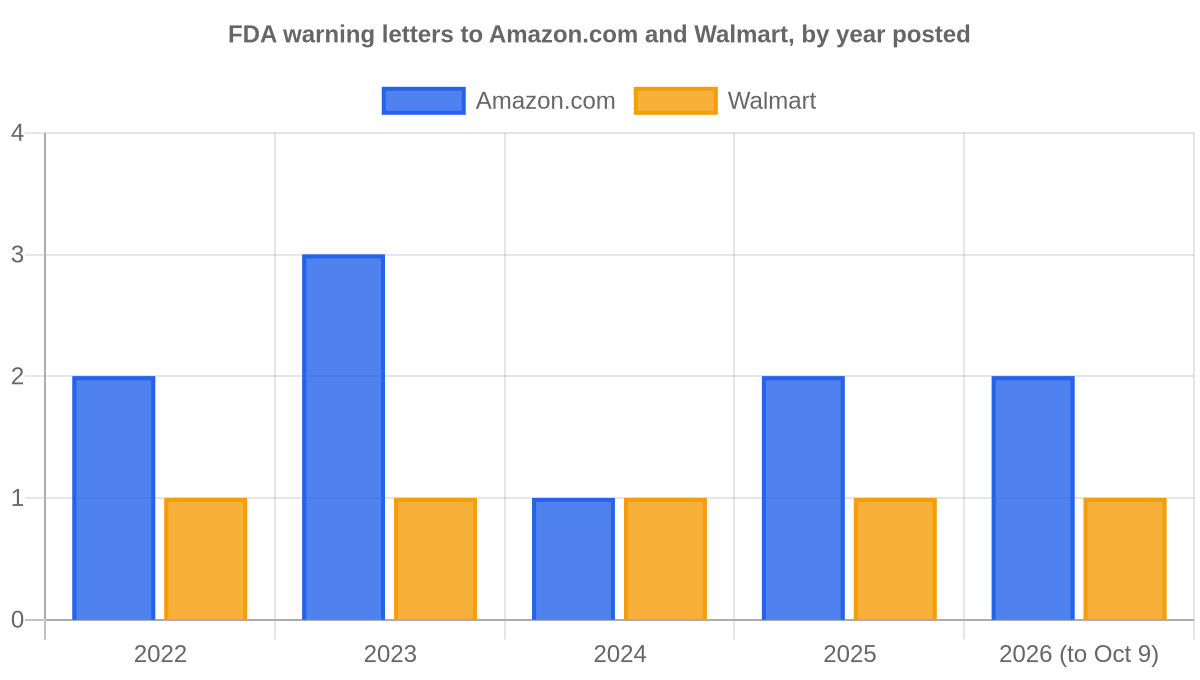
This is Amazon's tenth FDA warning letter in our records, which run back to 2021. The first came in August 2022, over mole and skin tag removers. Since then FDA has written to Amazon about Artri King supplements hiding diclofenac, molluscum treatments, pink-eye drops, supplements laced with sildenafil and tadalafil, chemical peels, injectable fat dissolvers, tattoo numbing creams, phimosis treatments, and now herpes remedies. Walmart has five, including last December's letter over its handling of the ByHeart infant formula botulism recall.
The structure repeats. In August 2023 FDA posted letters to Amazon, Walmart, and four sellers over molluscum products on the same day. Our reading is that the platform letter is the efficient part. One letter to a marketplace can clear listings from many sellers faster than chasing each one, and the brand letters set the record if FDA has to escalate.
What to watch
- Ibogaine comments close November 20. FDA's request for information on early-phase trials floats a starting dose no higher than 10 mg/kg and asks about cardiac and neurologic monitoring.
- Traceability meeting, November 6. Register by October 26 to speak.
- AI updates need clearance. O.N. Diagnostics' warning letter says swapping in a new machine learning algorithm for vertebral landmarking in VirtuOst VFA 3.0.0 required a new 510(k).
- GLP-1 internet pharmacies. Two more letters, to Cheap Medicine Shop and Online Generic Medicine, for selling unapproved injectable semaglutide to U.S. consumers.
Policy Canary tracks every FDA action, warning letters, recalls, guidance, and rules, against the specific products you make, by name and by ingredient. See what we would flag for your products.
Get this in your inbox every Friday.
Free FDA intelligence digest. No account required.