Weekly FDA Roundup: FDA calls Empower Pharmacy's GLP-1 vitamin blends "essentially copies," and an Impella controller recall follows three deaths, September 19–25, 2026
FDA says Empower Pharmacy's tirzepatide-niacinamide and semaglutide-B12 vials copy approved drugs. Plus an Impella controller recall, oleander sold as tejocote, and 7 FSVP letters.
Adding niacinamide to tirzepatide does not make it a different drug when the prescriber's reason for the change is a pre-written line picked from a menu. That is the core of the warning letter FDA posted September 22 to Empower Pharmacy, a Houston compounding pharmacy. The same week brought a Class I recall of Abiomed's Automated Impella Controllers, tied to 37 serious injuries and three deaths, and the biggest one-day batch of import verification letters this year.
By the numbers
- 97 FDA actions posted September 19 to 25: 53 recalls, 17 warning letters, 12 Federal Register notices, 8 safety alerts, 2 rules, 2 proposed rule documents, 2 press releases, and 1 draft guidance.
- 40 Class I recall entries in FDA's September 23 enforcement report. 33 came from Taylor Fresh Foods and NatureBest Pre-Cut & Produce over Salmonella in jalapeño products, a cascade we are covering separately.
- 7 FSVP warning letters posted September 22, the most FDA has posted in a single day this year.
- 3 deaths and 37 serious injuries reported for Abiomed's Automated Impella Controller.
- Standout: "tejocote" supplements that FDA testing showed were toxic yellow oleander.
Lead story: FDA says Empower's GLP-1 blends are copies, and blames templated prescriptions
FDA inspected Empower's 503A pharmacy in Houston from November 3 to 14, 2025. The warning letter, dated September 18, names three products: tirzepatide/niacinamide at 17/2 mg/mL and 8/2 mg/mL, and semaglutide/cyanocobalamin (vitamin B12) at 5/0.5 mg/mL. FDA says they "appear to be essentially copies" of the approved semaglutide and tirzepatide drugs.
Section 503A lets a state-licensed pharmacy skip FDA approval, CGMP rules, and full labeling, but only if it does not regularly compound copies of a commercially available drug. FDA's enforcement discretion for copies ended March 5, 2025, for tirzepatide and April 24, 2025, for semaglutide. Since then the common workaround has been to add a vitamin and have the prescriber attest that the change makes a significant difference for that patient.
FDA went after the attestations. Investigators found prescriptions with no significant-difference determination at all, and others where the same statement appeared "repeated verbatim across many records," which FDA reads as text pre-generated for the prescriber to click. The letter names "third-party technology platforms that provide prescribers with pre-selected menu options" as the kind of setup that undermines the individual judgment the exemption requires. Monthly order counts from July through October 2025 are redacted, but FDA concludes the volume "suggests that differences... are pretextual."
Across the warning letters in our records since January 2024, this is the only one that charges a pharmacy with compounding copies "in inordinate amounts." It is also Empower's fourth warning letter since 2021, and the second to this Houston pharmacy. FDA wrote to it and to Empower's 503B outsourcing facility on April 2, 2025, largely over sterile practices. This letter adds new sterile findings, including media fill records whose vial counts did not match the summary report.
If you run a telehealth platform or prescribe through one using templated "significant difference" language, this letter is aimed at your workflow as much as at the pharmacy. Empower has 15 working days to respond.
Key developments
Abiomed's Impella controllers: 37 serious injuries, three deaths
On September 24 FDA posted a Class I recall covering every Automated Impella Controller, the console that runs Impella heart pumps. A plastic purge flag inside the purge pressure sensor can fail, so the controller stops recognizing the purge disc and alarms "Purge Disc Disconnected." As of August 17 Abiomed reported 37 serious injuries and three deaths. Hospitals can keep using them while Abiomed replaces the part. If the alarm fires, reinsert the disc, then switch to a backup controller. Abiomed notes that improper cleaning can damage the part, so check that staff clean the housing with mild detergent. Boston Scientific's Imager II angiographic catheters, the subject of an August 28 Early Alert, were formally made Class I, with two serious injuries reported.
Oleander sold as tejocote, and a "GLP-1" peptide FDA rejected twice
Global Mix of Middle Village, New York, recalled niwali Tejocote Capsules and Pieces after FDA analysis of two samples collected June 19 found they appear to be yellow oleander, which contains cardiac glycosides. Only five units sold, through eBay and Everymarket, and the seller has no way to contact the buyers. Separately, FDA warned BioDrive over Evolv GLP-1 Biomimetic, built on a yeast-derived "EV1-Peptide." BioDrive filed two new dietary ingredient (NDI) notifications, FDA objected to both over toxicity concerns, and the company sold the product anyway. An NDI objection is not a formality you can file and ignore.
Raw pet food, pig ears, and a warehouse full of rodents
FDA's veterinary center warned two raw pet food makers. State samples of Raaw Energy's products, made in New Jersey, tested positive for Salmonella, Listeria monocytogenes, and Campylobacter jejuni. Viva Raw recalled products in August 2025, but FDA called its corrective actions inadequate without documents showing high-pressure processing actually worked. Quantum Star's FSVP inspection began after FDA found Salmonella in pig ears it imported. On the human side, a Minnesota federal court entered a consent decree against warehouse operator Gold Star Distribution. FDA's late-2025 inspection counted nine live rodents, 17 dead ones, and eight live birds among pallets of rice, cat food, drugs, and cosmetics, after 26 state inspections since 2013.
Animal-testing language, vitamin D2 yeast, and a calcium sulfate petition
FDA issued a direct final rule swapping "animal" and "preclinical" for "nonclinical" in its drug and biologic regulations. It adds no requirements and takes effect February 4, 2027, absent significant adverse comments by December 7. A final order approved vitamin D2 inactive bakers yeast (new 21 CFR 172.383, from a Lallemand petition) in 18 food categories, with caps such as 400 IU per 100 g in yeast-leavened baked goods and 350 IU per 100 g in breakfast cereals. And FDA filed a petition from Doehler to list calcium sulfate as a color additive in coated candies, dry milk, whey products, powdered creamers, icings, and fillings. That is a filing, not an approval. Our reading: a white colorant pitched at uses where titanium dioxide is common, though the notice does not say so.
The bigger picture
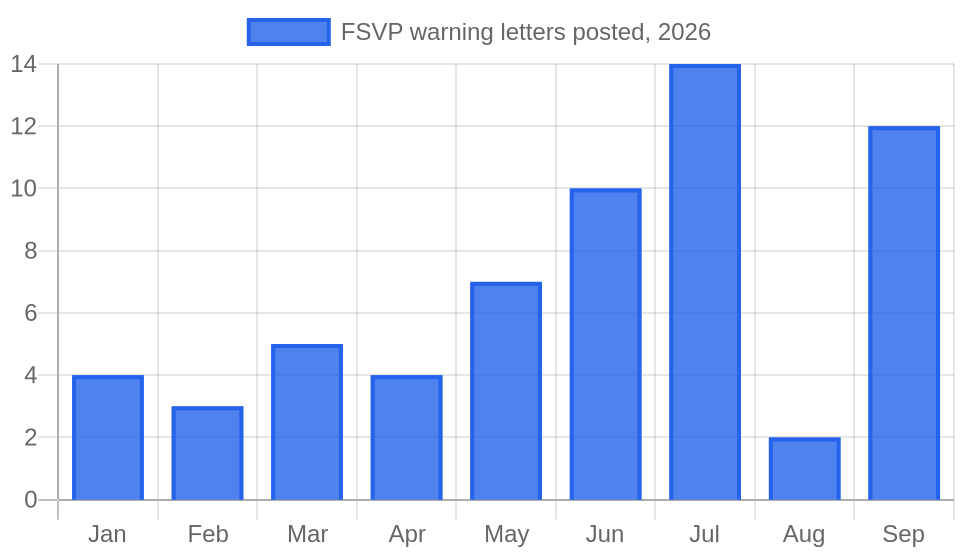
FSVP (Foreign Supplier Verification Program) enforcement is back near its July peak. Counting distinct 2026 warning letters that cite FSVP, the monthly tally ran 4, 3, 5, and 4 through April, then 7, 10, and 14 from May to July. August fell to 2, but August was slow across the board: FDA posted 24 warning letters that month, against 52 in July and 54 in September. September's FSVP count was 12.
The seven letters posted September 22 beat the previous single-day high of five on July 28. They are dated anywhere from April 10 to August 27, which suggests FDA holds finished letters and posts them in batches. The products were ordinary: flour, yams, feta, baklava, peanuts, and dried mushrooms that turned out to contain undeclared sulfites. All seven were cited for failing to develop an FSVP for at least some of their foods. If you import food, even for one specialty grocery, the written FSVP is the first document FDA asks for.
What to watch
- Empower's response is due 15 working days after receipt. The open question is whether other high-volume 503A pharmacies get the same letter.
- Deadlines: vitamin D2 yeast objections and the biosimilar user fee (BsUFA) public meeting, October 26; islet cell request for information, November 9; robotic surgical device draft guidance, November 24; nonclinical terminology comments, December 7.
- Huons saline, still spreading. AVID Medical and BD issued Class I corrections for kits containing recalled Huons sodium chloride ampules. FDA has posted 15 device notices mentioning Huons since June 3.
- Sprout seeds. Berlin Seeds recalled 950 pounds of alfalfa seed that traceback linked to a sprout grower in a multistate STEC and Salmonella Agona outbreak.
Policy Canary tracks every FDA action, warning letters, recalls, guidance, and rules, against the specific products you make, by name and by ingredient. See what we would flag for your products.
Get this in your inbox every Friday.
Free FDA intelligence digest. No account required.