Weekly FDA Roundup: the seed supplier behind the alfalfa sprout outbreak recalls 43,799 pounds, and Bausch & Lomb gets a sterility warning letter, September 12–18, 2026
Two weeks after FDA said it had not responded, the seed supplier in the alfalfa sprout outbreak recalled 43,799 lbs. Plus Bausch & Lomb's warning letter and a Medtronic Class I recall.
On August 31 FDA said publicly that the seed supplier in the alfalfa sprout outbreak had not responded to its recall recommendation. On September 15 FDA reported that the supplier had agreed to recall, and the next day's enforcement report put a name and a number on it: International Sprout Holdings of Cookeville, Tennessee, 43,799 pounds of alfalfa seed, Class I. It was a quiet week otherwise, with 33 actions and two warning letters, but one of those letters, to Bausch & Lomb, deserves a close read.
By the numbers
- 33 FDA actions posted September 12–18: 14 recalls, 8 notices, 4 safety alerts, 2 draft guidances, 2 press releases, 2 warning letters, and 1 final order.
- 5 entries in FDA's September 16 food enforcement report, 3 of them Class I.
- 2 warning letters, both posted September 15. That is the second straight week of two, after 12 on September 1.
- 184 serious injuries reported for Medtronic's Bravo CF capsule delivery device.
- Standout: 43,799 pounds of alfalfa seed, shipped to 16 states, Puerto Rico, and four other countries.
Lead story: the seed lot behind the sprout outbreak is recalled
We covered the start of this outbreak in August. FDA's outbreak investigation counted 55 illnesses in 15 states as of August 21: Shiga toxin-producing E. coli (serotypes O26:H11, O103:H25, and O168:H8) and Salmonella Agona, with four hospitalizations. Everything Sprouts of Minneapolis recalled its alfalfa sprouts on August 22.
On August 31 FDA said Everything Sprouts did not explain all the illnesses. Traceback had found at least one other grower that used the same alfalfa seed lot from a common supplier. FDA had recommended that the supplier recall the lot and tell its customers to recall sprouts grown from it. The supplier had told customers to stop using the seed, but had not responded to the recall recommendation.
On September 15 FDA reported the supplier had agreed to recall. FDA's September 16 enforcement report identifies it: International Sprout Holdings, which sells under the International Specialty Supply name, recalling lot SAL2-24JB, 43,799 pounds in 50-pound bags, for potential E. coli and Salmonella. The distribution matches the lot FDA describes: wholesale consignees in 16 states and Puerto Rico, plus Canada, Mexico, Tahiti, and Venezuela. FDA's enforcement record lists the recall as initiated by email on August 23.
If you grow sprouts, check your receiving records for SAL2-24JB today. Under the Produce Safety Rule (21 CFR 112.142(b)), a grower with reason to believe a seed lot may be contaminated, including because it has been associated with illness, must stop using it and keep sprouts grown from it out of commerce, whether or not the supplier recalls. One more point, and this is our reading: the rule's required spent irrigation water test names E. coli O157:H7 and Salmonella (21 CFR 112.144(b)). This outbreak's E. coli strains are non-O157 serotypes, so a method aimed only at O157 would not have flagged them.
Key developments
Bausch & Lomb: plant microbes matched consumer complaints
The warning letter covers Bausch & Lomb's Tampa plant, which makes sterile prescription and OTC drugs by aseptic processing (product names are redacted). From 2023 to 2025 the plant routinely recovered out-of-limit microbes in its ISO 5 areas, including water-associated organisms such as Serratia marcescens. Pseudomonas aeruginosa and Aspergillus brasiliensis found in the facility were the same species as organisms recovered from several consumer complaint samples. Investigators watched operators reach over open bottles and return jammed bottles to the line, and a July 2025 media fill on line 16 failed. The company argued its process was in control based on sterility tests and complaint rates. FDA's reply: a sterility test cannot be the sole basis for releasing sterile batches. If you contract out sterile products, ask your manufacturer for its environmental monitoring trends along with its release results.
Medtronic's Bravo pH capsule: 184 serious injuries
On September 15 FDA announced it had classified the Bravo CF capsule delivery device recall as Class I, following an August 27 early alert. The capsule, used to diagnose reflux, may fail to attach to the esophagus or to release from the delivery device. Risks include aspiration, esophageal perforation, and bleeding. Medtronic and its subsidiary Given Imaging reported 184 serious injuries and no deaths as of August 10. Some of these lots were in a June 2025 recall for the same failure, and Medtronic says this time the underlying cause is different. Affected lots expire on or before October 20, 2027.
Saline that might be potassium chloride
Otsuka ICU Medical recalled one lot (1042188) of 100 mL 0.9% sodium chloride after a customer found a 10 mEq potassium chloride bag inside a saline overwrap. Concentrated potassium given by mistake can cause fatal cardiac arrest. The lot shipped between December 30, 2025, and June 22, 2026, and no adverse events have been reported. The inner bag carries its own potassium chloride label, so reading the label on the bag itself, under the overwrap, will catch it. Separately, Par Health recalled two lots of dexmedetomidine in sodium chloride for particulate matter identified as cellulose or stopper material.
FDA says no to a 510(k) exemption for radiology AI
A final order published September 17 records FDA's denial of a petition, filed for Harrison.ai in October 2025, to exempt certain radiology computer-aided detection, diagnosis, and triage software from 510(k) when the maker already holds a clearance. FDA denied it on April 1. Makers of CADe, CADx, and CADt software under 21 CFR 892.2060 through 892.2090 still need a 510(k) for each new device. The title of the Federal Register document reads like an exemption, so read past it.
The bigger picture
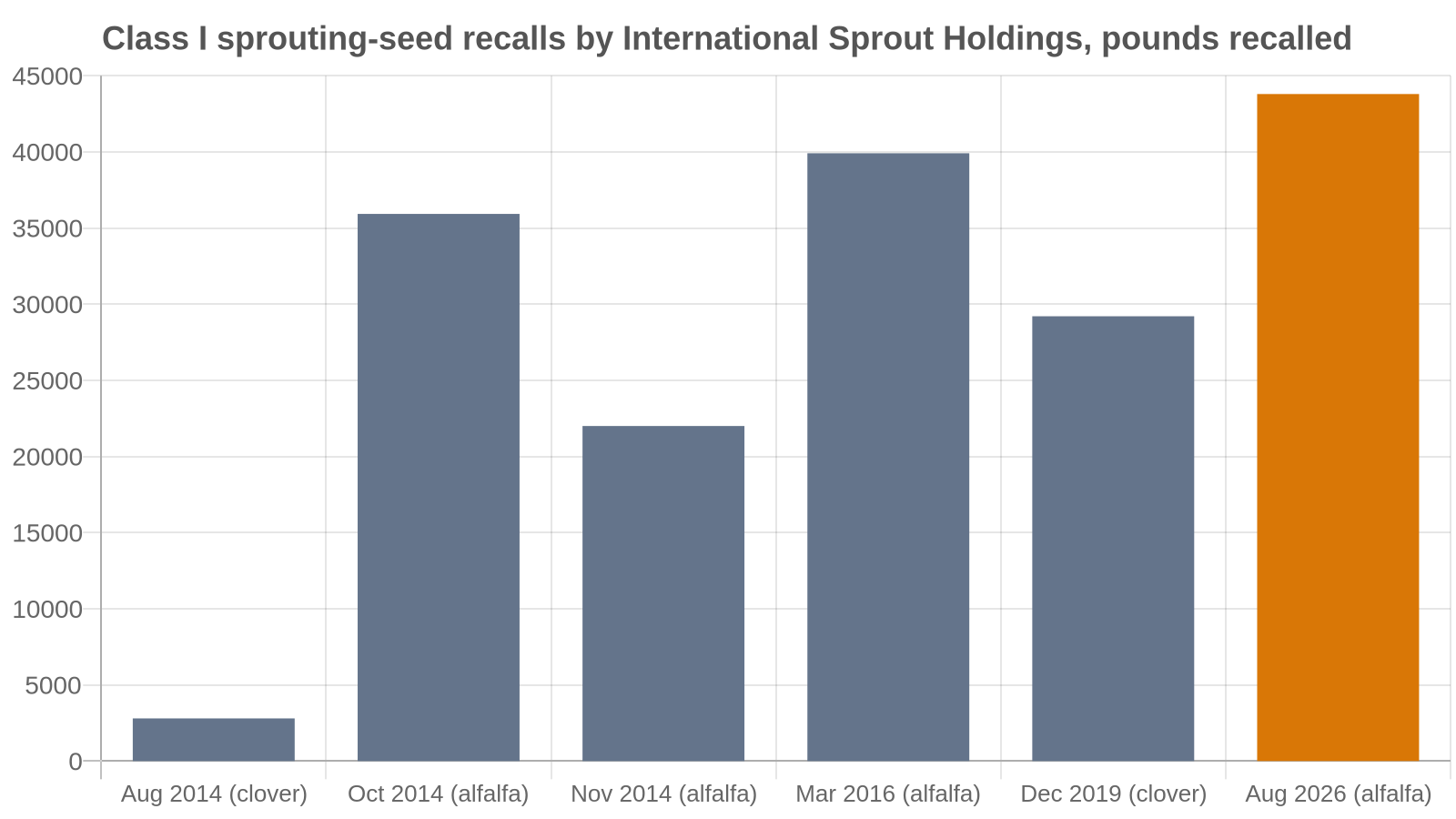
This is not International Sprout Holdings' first Class I seed recall. FDA's enforcement records show five earlier seed recall events by the company: crimson clover for Listeria in August 2014, alfalfa for Salmonella in October and November 2014 and again in March 2016, and clover for E. coli in December 2019. Counting this one, that is about 173,600 pounds of sprouting seed across six Class I events in 12 years.
Sprouts are grown in warm, wet conditions that let a few pathogens on a seed multiply, which is why the Produce Safety Rule gives them their own subpart. One seed lot also reaches many growers. Our reading is that for sprouts the seed lot is the first place to look, and supplier recall history should be part of how a grower qualifies a seed source. The record above is public.
What to watch
- Downstream sprout recalls. Lot SAL2-24JB went to wholesalers as well as growers, so more recalls of seed and sprouts are likely.
- Expedited IND Pilot applications close October 30, 2026. FDA's new pilot pairs drug sponsors with qualified research institutions for rolling pre-IND review.
- Comment deadlines: November 13 for the rare disease statistics docket; November 17 for the PMA electronic submission template draft guidance, CVM GFI #298 on veterinary monoclonal antibodies, and the BsUFA interchangeable biosimilar strategy.
- Pathogen-agnostic sequencing. FDA's Microbiology Devices Panel meets November 19.
- Ingredient certificates. GF Blends recalled flour and pizza mixes after plantain flour from PMF Global, labeled certified gluten-free, turned out to contain gluten. The finished products tested well above FDA's 20 ppm gluten-free limit.
- Patulin again. Wakefern recalled Wholesome Pantry Organic Unsweetened Apple Sauce after routine FDA testing, a week after Weis pulled apple cider for the same mold toxin.
- Approval: Fayuvi, the first gene therapy for Sanfilippo syndrome type A, on September 17.
Policy Canary tracks every FDA action, warning letters, recalls, guidance, and rules, against the specific products you make, by name and by ingredient. See what we would flag for your products.
Get this in your inbox every Friday.
Free FDA intelligence digest. No account required.