Weekly FDA Roundup: BMC reports a quiet 2024 firmware fix as a Class I recall, and FDA drops PABA from sunscreen, September 5–11, 2026
BMC reported a 2024 firmware rework of 20,160 sleep therapy devices 19 months later, and up to 196 may lack the fix. Plus PABA leaves sunscreen and a broccoli sprout outbreak.

The week's most instructive device recall concerned a problem that was fixed in 2024. BMC Medical reworked 20,160 Luna G3 APAP sleep therapy devices in a U.S. warehouse in late 2024 and told nobody. It reported that rework to FDA in July 2026, FDA classified it Class I on August 19, and BMC's public notice went up on September 8. Up to 196 units may never have received the fixed firmware. In the same week FDA finalized the removal of PABA and trolamine salicylate from the sunscreen monograph.
By the numbers
- 52 FDA actions posted September 5–11: 25 recalls, 11 notices, 9 device classification orders, 3 safety alerts, 2 warning letters, 1 guidance, and 1 withdrawn food additive petition.
- 19 entries in FDA's September 9 food enforcement report: 6 Class I, 4 Class II, 9 Class III.
- 2 warning letters, both posted September 8, to OTC drug maker Happy Farm Botanicals and clinical investigator Stephen J. Fallon.
- 22 Salmonella cases tied to broccoli sprouts from an Idaho grower.
- Standout: 196 APAP devices that BMC cannot confirm were fixed.
Lead story: a 2024 firmware fix becomes a 2026 Class I recall
The Luna G3 APAP (model LG3600) is an automatic positive airway pressure device for sleep apnea, imported by React Health. According to BMC's announcement, firmware version G3-2.00.76 shipped containing debug code. When the device runs at high pressure, high respiratory rate, and high peak flow all at once, the code triggers, the screen shows "Error," and the device shuts down. The patient stops getting therapy.
BMC caught the problem early. The affected units were built between September 11 and October 18, 2024, and from October through December 2024 BMC upgraded all 20,160 of them to version G3-2.00.77 at the importer's warehouse. FDA's enforcement report describes the recall (Z-2979-2026) as "retroactive reporting for 2024 rework." BMC's own notice says the corrective action "was not reported to customers."
It was not reported to FDA either, until July 15, 2026. Under 21 CFR Part 806, a manufacturer that corrects a device to reduce a risk to health generally has to report the correction to FDA within 10 working days. That 19-month gap is the story. Once BMC did report, it found that up to 196 units cannot be confirmed to have received the upgrade, and those devices shipped nationwide between October 2024 and July 2026. BMC says it has received no complaints or serious adverse event reports.
Patients and durable medical equipment (DME) providers can check a serial number at BMC's lookup page, and React Health is handling replacements. For device makers the lesson is procedural. Part 806 exempts stock recoveries, but only for devices still under the manufacturer's direct control, and these were already in the importer's warehouse. Reporting late turned a quiet fix into a public Class I recall.
Key developments
PABA and trolamine salicylate are out of the sunscreen monograph
On September 11 FDA announced final order OTC000008-1, which removes aminobenzoic acid (PABA) and trolamine salicylate as active ingredients from OTC Monograph M020. FDA concluded that sunscreens containing either one are not generally recognized as safe and effective (GRASE) because the risks outweigh the benefits. The order takes effect September 11, 2027. After that, a sunscreen using either as an active needs an approved new drug application. FDA says it is not aware of any such products on the U.S. market, so for most brands no action is required. If you hold an old formula or a private-label spec that lists either one as an active, retire it now. The rest of the 2021 proposed order, including other active ingredients, will come in later orders.
A second sprout outbreak in a month
Evergreen Fresh Sprouts of Moyie Springs, Idaho, recalled 215 cases of 4 oz broccoli sprouts linked to a multistate outbreak of Salmonella Bovismorbificans, with 22 cases as of September 9. A third-party lab also found Salmonella in sprouts with a September 16 use-by date. The sprouts went to three Washington distributors between August 24 and September 2 and may have reached stores in Idaho, Montana, and Washington. The company stopped producing broccoli sprouts on September 4. This is separate from the Minnesota alfalfa sprout outbreak we covered two weeks ago, which is still open.
Endotoxin in IV wellness vials
Centric Compounding of Houston recalled six lots of glutathione 200 mg/mL, Myer's Cocktail, and Tri-Immune Boost in 30 mL multidose vials after finding that a glutathione API (active pharmaceutical ingredient) carried elevated endotoxin. Centric has received nine reports of fever, chills, chest pain, nausea, or headache. The vials went nationwide by home delivery and to prescribers. IV hydration clinics and med spas should check lot numbers. Compounders should note the root cause sits upstream, in an ingredient; a supplier's certificate of analysis is not an endotoxin test. Ingredient testing is also the first violation in the week's warning letter to Happy Farm Botanicals of Hyattsville, Maryland, which accepted an API lot on smell and appearance alone and repeated findings from its 2024 inspection.
Undeclared ingredients fill the enforcement report
Six of the nine Class III entries came from Wonton Specialists, whose noodles, wonton skins, and dumpling skins contained FD&C Red No. 40 that was not on the label: 2,770 bags across six entries, sold in New York, New Jersey, and Pennsylvania. Certified colors must be declared by name (21 CFR 101.22(k)). Two Class I milk recalls involved "cheddar" products whose labels did not declare milk: Frankie's Organic Plant-Based Puffs Vegan Cheddar (322 cases) and 10,961 pounds of Savor Seasonings' bulk Organic Cheddar Type Seasoning, shipped to one customer in Canada. OLA-OLA instant pounded yam picked up a Class I milk entry after product for a Canadian customer went into bags printed for a UK customer.
The bigger picture
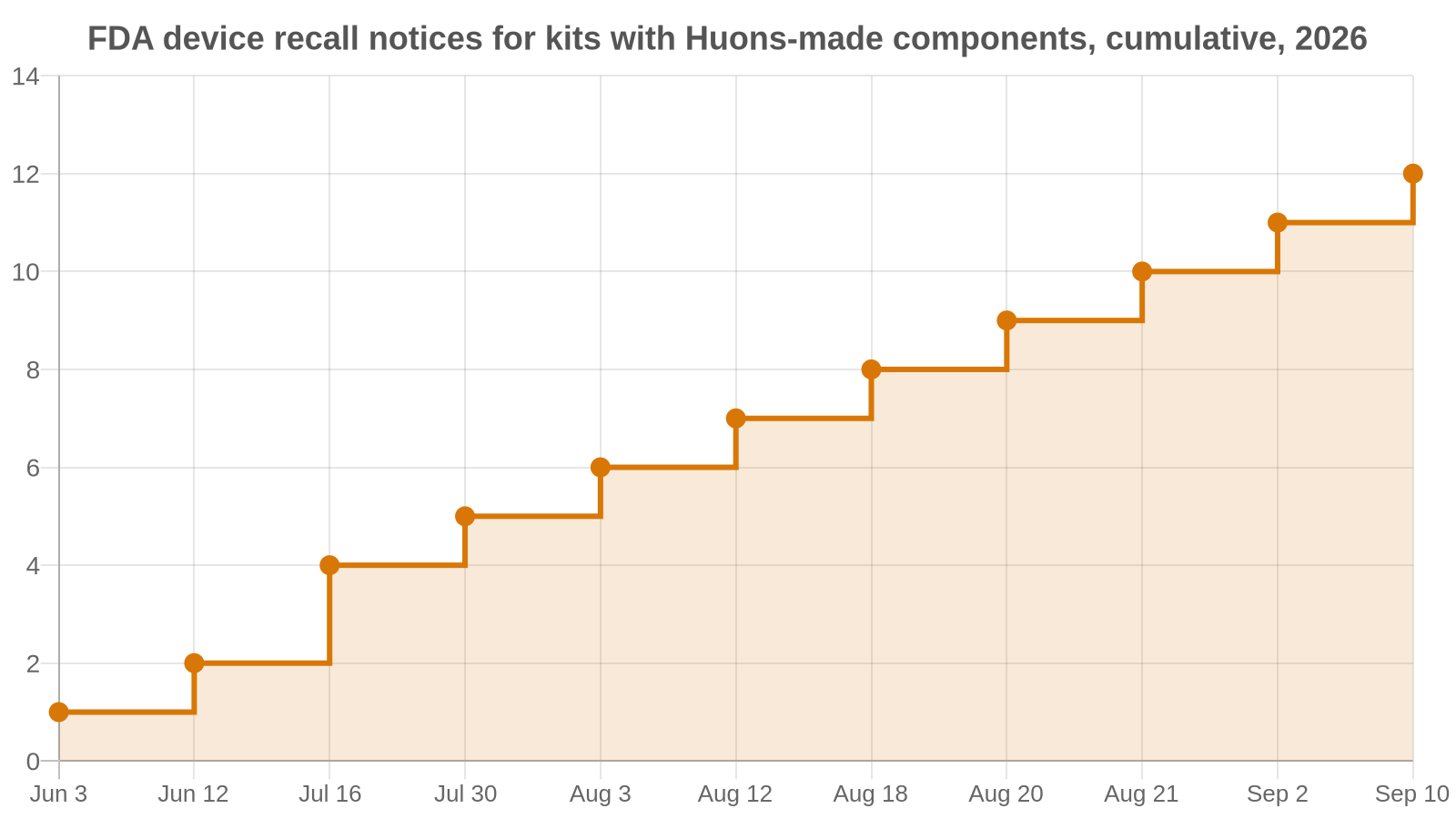
The Huons recall keeps moving through kits. Huons Co., a South Korean maker of injectable lidocaine, bupivacaine, and saline ampules, recalled product after a November 2025 FDA inspection. FDA's June warning letter describes a microbiology team leader who told staff to discard bioburden plates with significant growth and who admitted cutting completed pages out of a logbook with a knife. Every company that packed Huons ampules into a procedure kit then had to correct its own kits.
This week's addition was a Class I correction of Medical Action Industries epidural kits containing Huons saline flush ampules. By our count FDA has now posted 12 device recall notices and early alerts for kits with Huons-made components since June 3, from seven kit makers (BD, Medline, Arrow International, B. Braun, Argon Medical, Medical Action Industries, and AVID Medical). Two of the 12 reported serious injuries: B. Braun 35 and Argon 2. None reported deaths. If you assemble kits, your supplier list now includes your suppliers' suppliers.
What to watch
- The BMC serial-number check. DME providers should run their Luna G3 inventory and patient list through BMC's lookup before the issue reaches patients one at a time.
- Made Fresh Salads. The Bay Shore, New York maker recalled all its ready-to-eat deli salads and cream cheeses after FDA and company environmental samples tested positive for Listeria monocytogenes. FDA has not yet classified it.
- Jalapeños, still. Ron's Home Style Foods added Class I entries for pico de gallo and salsa made with possibly contaminated jalapeños (2,270 pounds total, Arkansas, Oklahoma, and Texas).
- Flu strains on October 1. FDA's vaccines advisory committee meets to pick 2027 Southern Hemisphere influenza strains.
- FY2027 priority review voucher fee: $1,798,596, effective October 1.
- Nine device classifications codified. FDA published final orders for De Novo classifications granted between July and September 2023, including cardiovascular machine learning-based notification software, now class II with special controls.
Policy Canary tracks every FDA action, warning letters, recalls, guidance, and rules, against the specific products you make, by name and by ingredient. See what we would flag for your products.
Get this in your inbox every Friday.
Free FDA intelligence digest. No account required.