Weekly FDA Roundup: five "research use only" peptide sellers get warning letters, and a spinal cord lead is tied to 1,081 serious injuries, August 29–September 4, 2026
FDA warned five online sellers that a "research use only" label doesn't make injectable semaglutide or retatrutide legal. Plus a Class I spinal cord lead recall and Fresenius's leaking bags.
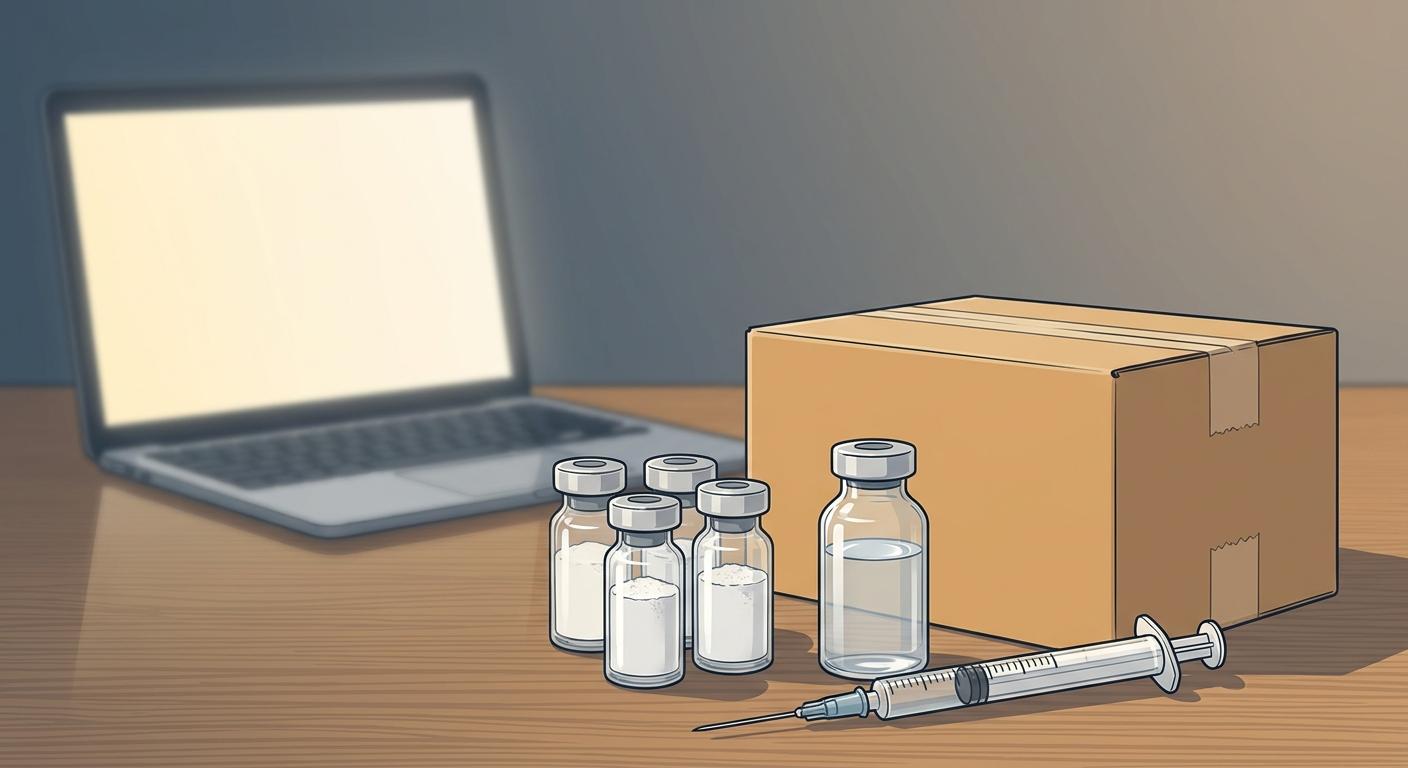
On September 1 FDA posted five warning letters that read almost word for word alike. All five went to online sellers of injectable peptides and carry the same August 24 date. The point in every one is that printing "research use only" on a vial of semaglutide or retatrutide does not stop it from being an unapproved drug when the website describes weight loss and sells the water to mix it with. The same week brought a Class I recall of a Boston Scientific spinal cord stimulator lead tied to 1,081 serious injuries.
By the numbers
- 67 FDA actions posted August 29 to September 4: 29 recalls, 14 Federal Register notices, 12 warning letters, 6 safety alerts, 5 press releases, and 1 draft guidance.
- 12 warning letters, all posted September 1: 5 to peptide sellers, 5 to drug manufacturers for CGMP (current good manufacturing practice) violations, and 2 to food importers.
- 7 Class I recall entries, led by undeclared peanuts in Khong Guan rice balls and Salmonella in bettergoods pistachio butter.
- 14 Class II entries, including six Outshine fruit bar flavors pulled over possible glass.
- Standout: 1,081 serious injuries reported for Boston Scientific's Infinion CX lead.
Lead story: "Research use only" did not protect five peptide sellers
The five recipients were TXP Innovations, doing business as Tex Peptides (Dallas), Royal Peptides (Boynton Beach, Florida), NuScience Peptides (Cornelius, North Carolina), Peptide Partners (Sarasota, Florida), and Peak Performance Peptides (Phoenix). FDA's drug center found the violations by reviewing their websites in July 2026, with no inspection.
All five sold semaglutide, retatrutide, PT-141 (bremelanotide), and tesamorelin, and four also sold tirzepatide. Every one also sold bacteriostatic water, and that detail does a lot of work in the letters. FDA treats the diluent as evidence: if you sell a lyophilized peptide plus the sterile water to reconstitute it, you are supplying the means to inject it. Royal Peptides went further, offering a "peptide guide" and a "peptide calculator."
The disclaimers were all there. The labels said "research use only," "not for human or veterinary use," or "not for human consumption." FDA's answer, in a footnote repeated across the letters, is that evidence from the websites establishes the products are intended as drugs for human use. Royal Peptides' comparison page cited trial weight loss of up to 22.5% for tirzepatide and 24.2% for retatrutide. Peptide Partners quoted research suggesting semaglutide could protect brain cells in diseases like Alzheimer's. Under 21 CFR 201.128, that kind of copy defines intended use, whatever the vial label says.
Each company has 15 business days to respond, and the letters warn of seizure and injunction. If you sell peptides, or run a supplement shop eyeing a "research" shelf, know that FDA reads the whole site. Blog posts, comparison pages, dosing tools, and bundled products all count toward intended use.
Key developments
A spinal cord stimulator lead with 1,081 serious injuries
On September 3 FDA posted a Class I recall of Boston Scientific's Infinion CX Lead, models SC-2317-50 and SC-2317-70, used in spinal cord stimulators for chronic back and limb pain. Stress at the anchor site can fracture the lead, leading to inadequate stimulation or surgery to replace it. Boston Scientific reported 1,081 serious injuries and no deaths as of May 27. The recall covers unused leads only, and FDA recommends no extra monitoring for implanted patients beyond routine follow-up. For scale, the B. Braun spinal anesthesia kit recall we covered in July cited 35 serious injuries. This is also Boston Scientific's third high-risk device action in just over a week, after the ENROUTE Class I recall and the Imager II catheter alert last week.
Fresenius waited eight months to recall leaking dialysis bags
The warning letter to Fresenius Medical Care covers its Ogden, Utah plant, inspected March 2 to 6. In August 2025 the company opened an investigation into leaking bags of Delflex peritoneal dialysis solution, eventually logging 35 complaints covering about 156 bags. Its own risk matrix named peritonitis as a potential harm at the highest severity. The company instead assigned the lowest severity, with the harm listed as "damage of property," and did not recall until April 2026, after the inspection. FDA rejected the idea that patients can be relied on to spot leaks. Quality teams that score complaint trends should read this one.
Sterile drug and API makers: mold, rust, and overwritten data
Jabil's Pharmaceutics International plant in Cockeysville, Maryland, a contract maker of sterile injectables, closed a sterility failure involving the fungus Ustilago spermophora with a root cause of "undetermined," and had recurring mold recoveries in its ISO 5 filling area. Reliance Life Sciences in Navi Mumbai overwrote integrity-testing data and has been on Import Alert 66-40 since July 9. Shoolin Pharma Chem in Gujarat makes sildenafil citrate and tadalafil APIs (active pharmaceutical ingredients) used by U.S. compounding pharmacies; investigators found residue and apparent rust on shared equipment, and FDA added it to Import Alert 66-40 on August 11. Compounders should check their API suppliers. PReye of Wheat Ridge, Colorado, had no functioning quality unit and was selling "PReye Vitamin SEE" eye drops with cataract and macular degeneration claims.
Allergens on the label, but not in English
Byron White Formulas recalled three herbal supplements that listed walnut only as "Juglans nigra hull." FDA's Class II entries cover 32,680 units across the three products. Federal allergen labeling (FALCPA) requires the food source to be named in plain terms, and a Latin botanical name does not do that. Lidl's Eridanous Greek-style shortbread reached U.S. stores with foreign-language-only labels, leaving wheat, soy, milk, eggs, and coconut undeclared. If you import finished goods or put botanical names on labels, check both.
The jalapeño outbreak's tail, and an FSVP letter on peppers
Sirna & Sons Produce of Ravenna, Ohio, added a Class I entry for 249 one-pound bags of jalapeños sold to food service in Ohio and Pennsylvania, citing Salmonella Javiana. Separately, Mesquite Gourmet of San Antonio received a Foreign Supplier Verification Program letter for importing fresh Anaheim, habanero, and jalapeño peppers without an FSVP. The letter is dated August 4 and its supplier names are redacted, so nothing in it ties Mesquite to the outbreak.
The bigger picture
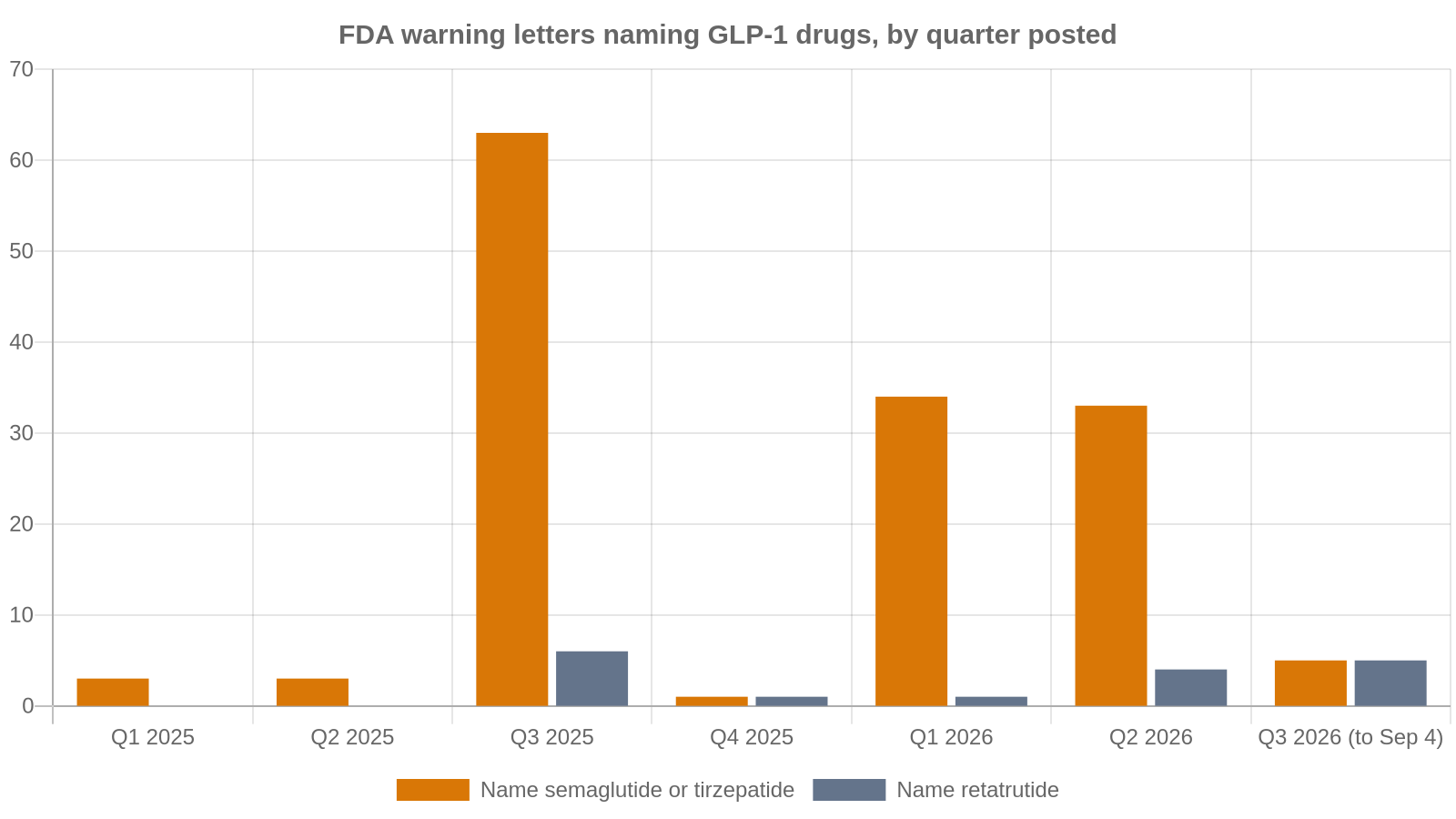
FDA has posted 142 warning letters naming semaglutide or tirzepatide since January 2025, and they come in bursts. The biggest was the third quarter of 2025: 63 letters, 55 of them to websites selling unapproved drugs to U.S. consumers. The first half of 2026 shifted to false and misleading claims, including the 25 telehealth letters we covered in June. This quarter the agency is back to online sellers, and all five of its GLP-1 letters so far went to sites marketing "research" peptides.
Retatrutide is the tell. Letters naming it arrive in batches: six on September 16, 2025, four on April 7, 2026, and five this week. Our reading is that FDA returns to the research-peptide channel every few months with a template letter built from a website review. Each letter is cheap to issue, so expect more.
What to watch
- Peptide seller responses are due 15 business days after receipt.
- Botanical drug comments close November 3, 2026. FDA's request for information runs alongside a joint FDA and European Medicines Agency workshop on September 25.
- Neonatal starter parenteral nutrition. FDA issued immediately-in-effect guidance after two outsourcing facilities that made these IV nutrition products announced they were shutting down permanently.
- New World screwworm. A Federal Register notice on August 31 covered three animal-drug emergency use authorizations (Zoetis, Felix Pharmaceuticals, and Alberta Vet Labs), and on September 3 FDA extended Capstar and its generic (nitenpyram) to dogs and cats.
- Frozen berries. Frutas y Hortalizas del Sur expanded its E. coli O145:H28 recall to one lot of Great Value Organic Triple Berry Blend sold at Walmart stores in 16 states.
Policy Canary tracks every FDA action, warning letters, recalls, guidance, and rules, against the specific products you make, by name and by ingredient. See what we would flag for your products.
Get this in your inbox every Friday.
Free FDA intelligence digest. No account required.