Weekly FDA Roundup: 13 Class I entries trace back to one jalapeño distributor, and sprouts are tied to 55 illnesses, August 22–28, 2026
FDA classified the jalapeño Salmonella outbreak recalls as Class I, starting with 53,760 cases at the source. Plus sprouts tied to 55 illnesses and Boston Scientific's ENROUTE recall.
FDA's August 26 enforcement report put hard numbers on the jalapeño outbreak that surfaced earlier this month. Thirteen of the week's 18 Class I recall entries trace to fresh jalapeños, and one of them is the upstream source: Coast Citrus Distributors, recalling 53,760 cases of Mexican-grown peppers over possible Salmonella Javiana. A separate outbreak tied to Minnesota alfalfa sprouts had reached 55 reported illnesses by the time the recall went out.
By the numbers
- 67 FDA actions posted August 22 to 28: 35 recalls, 13 Federal Register notices, 11 safety alerts, 5 press releases, and 1 draft guidance.
- 18 Class I recall entries: 13 tied to jalapeños, 4 Publix frozen berry products, and 1 Lidl spice mix. Every one was pathogen-driven.
- 2 warning letters, the fewest of any week since May: R3 Medical Companies (umbilical cord products) and Vargas Produce (Foreign Supplier Verification Program).
- 55 reported illnesses linked to Everything Sprouts alfalfa sprouts.
- Standout: Boston Scientific's ENROUTE carotid system is now formally a Class I recall, as we expected in July.
Lead story: The jalapeño outbreak gets its Class I paperwork
The recalls themselves started weeks ago. Between August 8 and 12, Taylor Fresh Foods, NatureBest Precut & Produce, and Whole Foods Market pulled salsas and dips after Coast Citrus recalled fresh jalapeños from Sinaloa, Mexico. FDA's most recent outbreak update, on August 19, counted 431 people infected with Salmonella Javiana in 32 states, with 57 hospitalizations and no deaths. Of 224 people interviewed, 203 had eaten at a Mexican-style restaurant.
What changed this week is the classification, and with it the first look at volume. The Coast Citrus entry covers 53,760 cases sold in bulk Coast Tropical packs of 10 to 40 pounds, mainly to wholesale distributors in central and East Coast states. From there the peppers were "further distributed nationwide" for further processing. As of August 10, no retail distribution had been identified.
That last detail matters most. These peppers mostly reached consumers as guacamole and pico de gallo, not as peppers. The downstream entries show it:
- Whole Foods (WFM Purchasing): 10 entries covering guacamoles, salsas, a Trio Dip, and the mango pineapple salsa served on a Caribbean turkey burger. FDA lists 12,995 units total across 13 states.
- Get Fresh Produce: 802 cases of 2-lb and 10-lb boxes in Illinois, Indiana, Michigan, and Wisconsin.
- Dairyland Produce: 7,456 lbs of repackaged jalapeños in Louisiana and Texas. Only the 5-lb bag reached retail shelves.
If you make anything with fresh jalapeños, the recalled products are long past their best-by dates. The work now is records. Pull your receiving logs for July and August, check them against the Coast Tropical labels and UPCs in the recall notices, and, as FDA's update advises, work with your supplier to confirm where your peppers came from. A processor who can't answer that on day one is the one who recalls a whole product line out of caution.
Key developments
Sprouts tied to 55 illnesses in Minnesota and Wisconsin
On August 22 Everything Sprouts of Minneapolis recalled alfalfa sprouts sold under the Everything Sprouts and Calco brands, lots 222, 223, 225, 226, and 230, over possible Shiga toxin-producing E. coli (STEC) and Salmonella. The same sprouts went into two of its sprout mixes. Distribution ran May 27 to August 21, to wholesalers and grocers in Minnesota and Wisconsin. The company says federal and state partners had received 55 illness reports related to alfalfa sprouts. On August 28 it expanded the recall to a radish mix, with no illnesses reported for that product. Sprouts get their own section of the Produce Safety Rule (21 CFR Part 112, Subpart M) for a reason. If you use sprouts in sandwiches or salads, check those lot numbers.
Publix frozen berries reach Class I, a month after the recall
On July 29 Publix recalled all lots of its GreenWise Organic frozen blueberries and whole mixed berries over E. coli O145:H28. That followed a July 3 recall of one blueberry lot by the Chilean supplier, Frutas y Hortalizas del Sur. This week FDA classified the Publix action as Class I: four entries, 182,094 units, eight states from Virginia to Florida. Frozen fruit often goes into smoothies uncooked, which is why possible STEC contamination rates at the top level.
Boston Scientific: one Class I recall confirmed, another catheter pulled
In July we said to expect a Class I designation for the ENROUTE Transcarotid Neuroprotection System after an Early Alert on separating sheath tips. On August 26 FDA made it official, with one serious injury and no deaths reported as of July 9. Two days later came a new Early Alert: Boston Scientific is pulling all Imager II angiographic catheters because the tips were made with reduced stabilizing agents and can degrade or detach inside a blood vessel. That one carries two serious injuries and no deaths as of July 16. Separately, Medline and Avid Medical told customers to destroy entire convenience kits, rather than pull one component, if they contain BD ChloraPrep applicators from lots flagged for Aspergillus penicillioides contamination.
Particulate matter in IV bags from two suppliers
Baxter recalled three products on August 25: one lot of 70% Dextrose Injection with stainless steel particles, one lot of anticoagulant sodium citrate solution with fiberglass (shipped to a single customer), and two lots of 0.9% Sodium Chloride Injection, also fiberglass. B. Braun followed with three lots of 0.9% Sodium Chloride in 100 mL PAB containers, citing zinc oxide particles. Everyday fluids are easy to miss on a recall list, so hospital pharmacies should check lots against the Baxter dextrose notice and its companions.
A fat burner with fluoxetine by day and DNP by night
FDA testing of Lipofit Extreme Fat Burner 2.0, sold online by Ana Salazar Modela Tu Cuerpo Inc. of Davie, Florida, found fluoxetine (the antidepressant in Prozac) in the morning tablets and 2,4-dinitrophenol in the evening tablets. DNP is a toxic pesticide and herbicide chemical, illegally sold for weight loss and approved for no use at all. The company recalled lot 25M12F. FDA also warned consumers about Qu Feng Huo Lou Dan, a pain product hiding the steroid dexamethasone.
The bigger picture
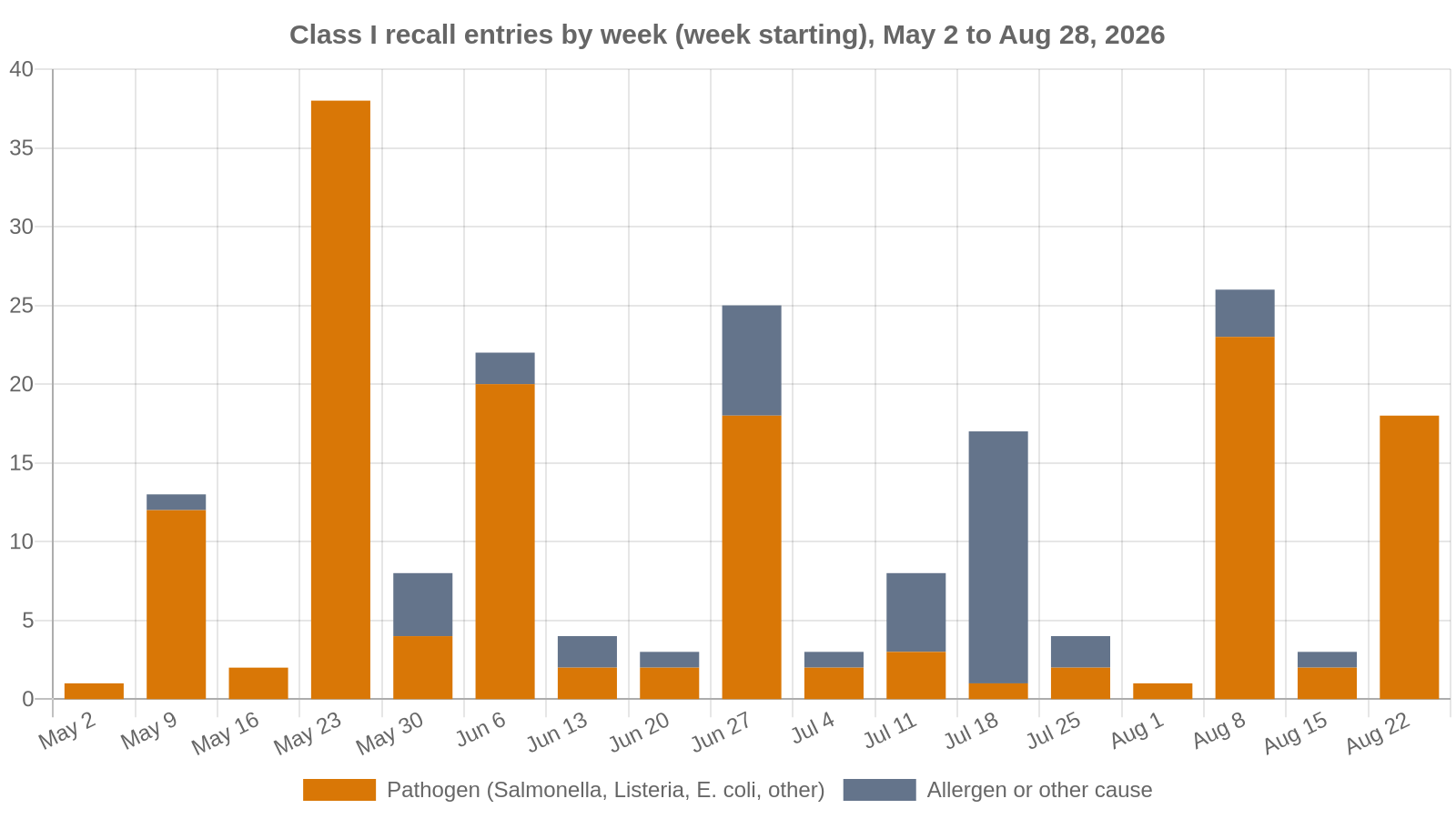
Pathogens, not allergens, are driving the top tier of recalls this year. Since May 2, FDA's enforcement reports have carried 196 Class I recall entries, and 151 of them (77%) cited a pathogen. The exception was the week of July 18, when one ice pop maker's undeclared allergens produced 16 entries on its own. This week ran 18 for 18 on pathogens.
One caution: these are product-level entries, so one event can produce many (Whole Foods alone accounted for 10 this week). The pattern still holds. The big Class I weeks this year (milk powder in May, jalapeños in August) came from contaminated ingredients that traveled through other companies' products. Our reading: in 2026 the most expensive surprises have come from the supplier list, not from the recalling company's own plant.
What to watch
- Jalapeño outbreak updates. Watch FDA's outbreak page for new case counts and for more processors finding Coast Citrus peppers in their July and August receiving records.
- Everything Sprouts. The radish mix expansion came six days after the first notice. More are possible while the source investigation continues.
- Draft CVM GFI #256B comments close November 27, 2026. The draft says FDA generally would not extend enforcement discretion to CGMP violations at federally-registered facilities that compound animal drugs from bulk substances.
- Approvals: Rasonque (daraxonrasib), a RAS inhibitor for metastatic pancreatic cancer, on August 26, and Lisraya (brepocitinib), the first oral dermatomyositis drug, on August 27. Abbott's Libre Duo, which tracks glucose and ketones together, got De Novo authorization.
- New World screwworm. Another emergency use authorization on August 27, for Bimectin, a generic ivermectin injection for cattle.
Policy Canary tracks every FDA action, warning letters, recalls, guidance, and rules, against the specific products you make, by name and by ingredient. See what we would flag for your products.
Get this in your inbox every Friday.
Free FDA intelligence digest. No account required.