Weekly FDA Roundup: FDA sketches how it might regulate generative AI devices, 11 warning letters land in a day, and the Huons kit recalls hit their busiest week, August 15–21, 2026
FDA asked 26 questions about regulating generative AI medical devices, posted 11 warning letters in one day, and logged three more kit actions tied to recalled Huons drug components.

FDA's device center put its thinking on generative AI devices out for public feedback this week. On August 18 it released a discussion paper on how it might regulate GenAI-enabled medical devices, with 26 questions and a comment deadline of October 19. The paper is not guidance and creates no requirements. It does show where CDRH's head is, and one line in it should get the attention of anyone building a patient-facing chatbot: a "talk to your doctor" disclaimer may not lower your risk tier.
By the numbers
- 55 FDA postings between August 15 and 21.
- 11 warning letters, all posted August 18. Six went to drug makers or a drug testing lab.
- 3 Class I recall entries: two for Midwest Poultry Services eggs and one for Bazzini chocolate bites with undeclared peanuts.
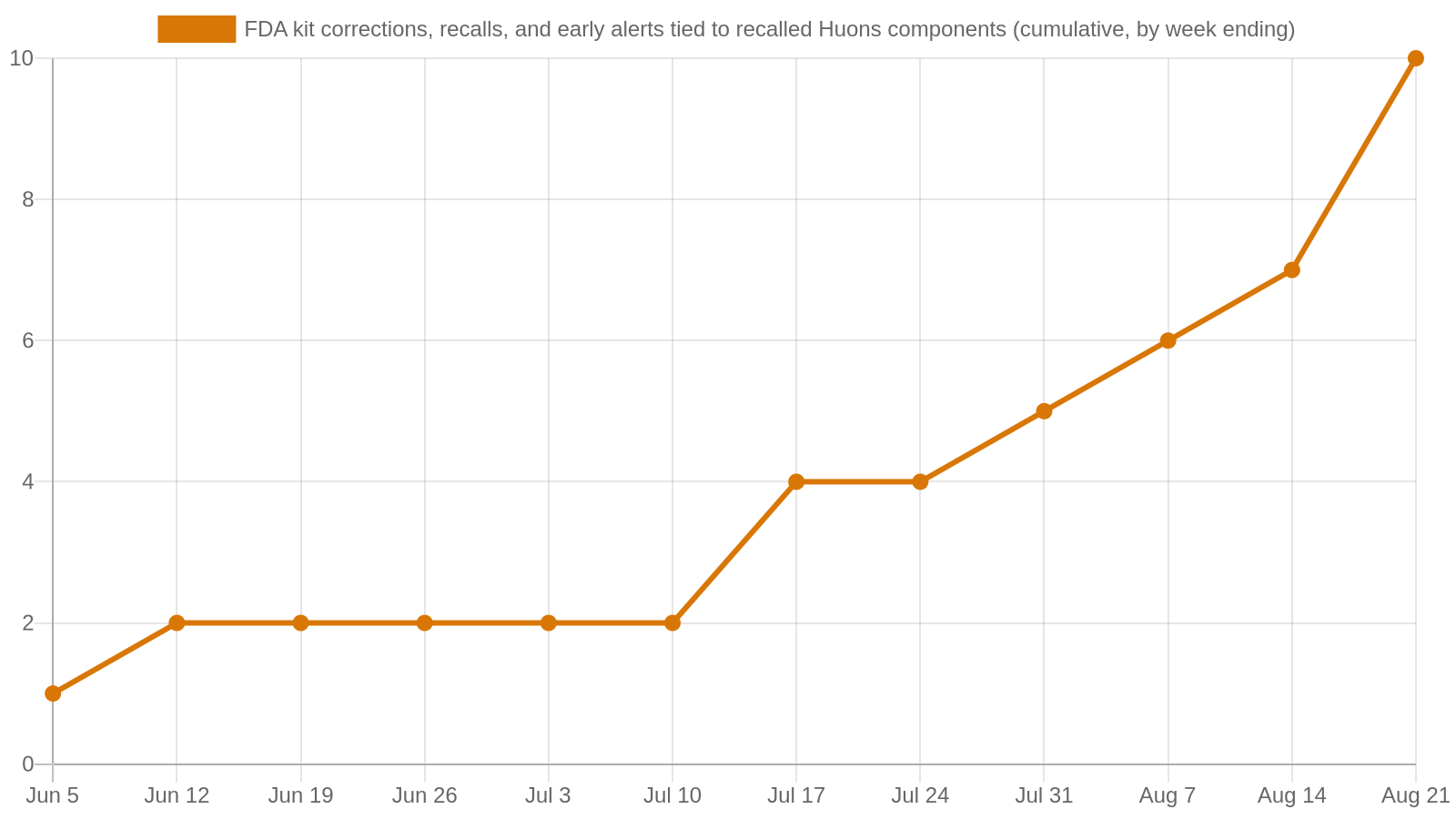
- 3 device actions in one week tied to recalled Huons components, the most of any week since the thread began in June.
- 3 color additive petitions filed for plant-based or natural-source colors.
- Standout: the GenAI discussion paper, Docket FDA-2026-N-7874.
Lead story: FDA floats a risk framework for generative AI devices
The discussion paper, from CDRH's Digital Health Center of Excellence, builds on the November 2024 Digital Health Advisory Committee meeting on GenAI. It covers risk assessment, premarket evaluation, postmarket monitoring, foundation models, and agentic AI.
The risk idea is a two-axis grid. One axis is what the software does, from giving non-directive information up to acting on its own. The other is how bad the harm is if someone relies on a wrong output. FDA's examples are concrete. Telling a patient to put hydrocortisone cream on poison ivy sits low. Telling a patient to change a basal insulin dose sits high. Autonomously prescribing antibiotics for confirmed strep throat is lower risk than autonomously starting a stroke thrombolytic order set.
Two details matter for product teams. First, CDRH is considering treating "action-directing" outputs as higher risk than plain information, and it says whether output is directive depends on substance and context, not solely on words like "recommend" or "consider." It is also considering whether a "talk to your doctor" or "I am not a medical professional" line makes a directive answer any less directive. Our read is that disclaimers will not carry much weight. Second, FDA floats a "competency-based" premarket review modeled on how physicians are trained and evaluated: benchmarking the device as deployed, then clinical confirmation.
On foundation models, FDA suggests a voluntary Foundation Model Master File, where a model developer could share architecture, training data provenance, known failure modes, and benchmark results with FDA. The agency acknowledges that model developers "may have limited incentive to disclose safety-relevant information."
What to do: if you build software that answers patient or clinician questions with a large language model, map each function onto both axes now, and decide whether to comment by October 19. If you only use GenAI for clinical documentation or workflow support, FDA notes those functions may not be the focus of its device oversight.
Key developments
Eleven warning letters in a day, led by sterile drugs and a testing lab
All 11 letters posted August 18. The one to watch went to Auriga Research, a contract testing laboratory in Bengaluru, India. Investigators found microbial test sheets with blank entries and repeated testing until a result passed, which FDA calls "testing into compliance." If a lab like this tests your product, its CGMP problems become your problem. Eugia Pharma Specialities was cited for aseptic lines lacking proper barrier design, and K.C. Pharmaceuticals kept releasing sterile OTC drugs after media fill failures in 2024. Tianjin Kilo Pharmaceutical, which sold APIs to 503A compounding pharmacies, was already on Import Alert 66-40 as of July 21. OTC makers Safrel Pharmaceuticals and Suretec Innovations, dialysate maker Nipro Renal Solutions, raw pet food maker Waves and Wine (Listeria in frozen cat and dog products), DeJong Family Dairy, and two vape sites that sold to buyers under 21 round out the list.
Three more kits pulled into the Huons recall
BD posted an early alert for convenience kits and procedure trays containing recalled Huons sodium chloride ampules. Medline issued a Class I correction for hip, knee, and C-section kits that contain B. Braun components built on Huons bupivacaine. Medical Action Industries posted an early alert for epidural kits with Huons saline flush ampules previously recalled by Spectra Medical Devices. In each case the fix is the same: pull the ampule, keep using the rest of the kit.
The jalapeño outbreak grows, and the egg recall gets its classification
FDA's August 19 update on the Coast Citrus jalapeño outbreak counted 431 people sick in 32 states and 57 hospitalizations, up from 345 in 27 states on August 5. On August 20 FDA created a Major Product Recalls page to track downstream recalls. Separately, the Midwest Poultry Services egg recall we covered in July received two Class I entries totaling 1,589,577 dozen, sold under Kroger labels, including Simple Truth, in six states. Bazzini's Dark Chocolate Coconut Almond Bites, 1,382,916 pieces shipped to Washington, also went Class I for undeclared peanuts.
Three petitions for natural colors
On August 19 FDA announced three color additive petitions. GNT USA wants safflower extract approved for various foods. The Gardenia Blue Interest Group wants expanded uses for gardenia (genipin) blue and a lower arsenic limit. The International Association of Color Manufacturers wants acetone allowed as a solvent in making carrot oil, with environmental assessment comments due September 18. These are filings, not approvals. Our read: color suppliers are positioning for food makers moving off petroleum-based dyes.
Two firsts: a blood-draw robot and a gene therapy
FDA granted De Novo authorization to Vitestro's Aletta, the first standalone robotic device that draws blood without hands-on operator work. One phlebotomist can supervise up to three units. FDA also gave accelerated approval to Genglycos (pariglasgene brecaparvovec-opnr), the first therapy for glycogen storage disease type Ia in patients 8 and older, based on a 31% reduction in daily cornstarch intake versus placebo.
The bigger picture
Huons committed on March 25 to a voluntary recall of all drugs made at its facility, after FDA recommended pulling every unexpired U.S. batch, according to the warning letter FDA issued in June. Since June 3 we count 10 device actions by kit makers who found Huons ampules in their bills of materials, and 3 of them landed this week, the most in any single week. Medline alone accounts for four. Its August 20 correction shows the second-order problem: kits recalled because they contain another manufacturer's components, which in turn contain Huons drugs. If you assemble kits, the question is whether your suppliers' components contain a recalled drug.
What to watch
- GenAI discussion paper comments close October 19, 2026 (Docket FDA-2026-N-7874).
- Draft guidance on choosing an ANDA or a 505(b)(2) application, replacing the 2019 version, with comments due October 19.
- Proposed list of device accessories suitable for Class I, comments due October 16.
- Testosterone use in menopausal women, an FDA public workshop on September 17.
- More Huons kit actions. BD and Medical Action Industries posted early alerts, which often precede a formal recall classification.
Policy Canary tracks every FDA action, warning letters, recalls, guidance, and rules, against the specific products you make, by name and by ingredient. See what we would flag for your products.
Get this in your inbox every Friday.
Free FDA intelligence digest. No account required.