Weekly FDA Roundup: FDA moves to make GRAS notices mandatory, one dairy's Listeria recall becomes 22 Class I entries, and jalapeño recalls spread, August 8–14, 2026
FDA proposed making GRAS notification mandatory, classified 22 Listeria recall entries tied to one Maryland cheesemaker as Class I, and watched jalapeño Salmonella recalls reach 26 states.
On August 11 FDA proposed a rule that would make GRAS notification mandatory. For decades a company could decide on its own that an ingredient was "generally recognized as safe," put it in food, and never tell the agency. If this rule is finalized, that path closes. The same week, a Maryland cheesemaker's June Listeria recall came back as 22 Class I entries, and the jalapeño Salmonella outbreak kept producing downstream recalls.
By the numbers
- 75 FDA postings between August 8 and 14, 49 of them recall entries or recall announcements.
- 26 Class I recall entries. 22 trace back to one Maryland cheesemaker, Clover Hill Dairy, and a company that repackaged its cheese.
- 7 Class II and 1 Class III recall entries.
- 5 jalapeño Salmonella recalls, most of them tied to the Coast Citrus outbreak.
- 3 warning letters, a quiet week for enforcement letters.
- Standout: the GRAS proposed rule, with comments due December 9, 2026.
Lead story: FDA proposes ending self-affirmed GRAS
The proposed rule would amend 21 CFR parts 170 and 570 to require a GRAS notice for any human or animal food substance marketed under the GRAS provision of the FD&C Act. Today that notice is voluntary. A company can convene its own experts, conclude its ingredient is GRAS, and sell it without FDA ever seeing the file. Under the proposal, FDA would treat a missing notice as a factor in deciding which substances get post-market review.
The scope is wider than new ingredients. "Food substances" here include substances that migrate into food from packaging. Uses already on the market get a time-limited option: a streamlined submission, due within one year after a final rule takes effect, which FDA would post on a public list. The proposed compliance date is 18 months after the effective date.
FDA proposes seven exceptions. The ones most companies will lean on are a use already covered by an FDA "no questions" letter, a substance listed or affirmed as GRAS in 21 CFR parts 182, 184, or 186, and a food contact substance with an effective notification (which only covers the supplier named in it). A "no questions" letter has limits: FDA writes that a changed manufacturing process or different use levels can take a use outside it.
Supplement companies should read the scope carefully. Dietary ingredients used in supplements fall outside the food additive definition, so they cannot be the subject of a GRAS notice. A supplement brand that also sells a functional beverage or a protein bar is a different case.
FDA puts the annualized cost at about $10.5 million and says outright that an "insufficient basis" finding for one ingredient could shift market share between competitors. Our read: if a conventional food you sell relies on a self-affirmed GRAS ingredient, ask your supplier now whether it plans to file in the one-year window. This is a proposed rule. Nothing changes until FDA finalizes it.
Key developments
One Maryland dairy's June recall returns as 22 Class I entries
On August 12 FDA classified 18 Clover Hill Dairy recall entries as Class I (H-1199-2026 through H-1216-2026), all for Listeria monocytogenes, plus four more for La Colonia Foods, which repackaged Clover Hill requesón under the La Colonia and Selectos Latinos brands. The list covers nearly the dairy's whole line, from requesón and cuajada to Old Bay cheddar. Most entries list quantity as unknown. The requesón entry lists 21,692 pounds to bulk distributors and 7,465 pounds at retail, distributed in Maryland, Virginia, and New York.
This is paperwork catching up with an outbreak. Clover Hill recalled requesón on June 9 and expanded to all its cheeses on June 18. FDA's outbreak page cited 12 people sick in four states as of its June 24 update, with 10 hospitalized, one death, and illnesses going back to March 2023. If you buy soft cheese in bulk and repack it, note that four of the 22 entries carry La Colonia's name, not Clover Hill's.
The jalapeño outbreak moves into packaged food
FDA and CDC have tied a multistate Salmonella Javiana outbreak to fresh jalapeños from a grower in Sinaloa, Mexico, distributed by Coast Citrus Distributors. FDA's August 5 update counted 345 people sick in 27 states and 36 hospitalized, and 177 of the 191 people interviewed had eaten at a Mexican-style restaurant. This week the recalls reached retail. Taylor Fresh Foods recalled salsas, guacamole, dips, burritos, and sandwiches sold at Kroger, Target, Trader Joe's, Walmart, and other chains in 26 states. Whole Foods pulled its own salsas and prepared foods in 12 states. NatureBest Precut & Produce and Salata Dressings recalled pico de gallo and a jalapeño avocado dressing sold in Texas and Louisiana, and Hardie's Fresh Foods recalled repacked jalapeño bags sent to two Texas Costco stores. If you buy jalapeños as an ingredient, trace them to the grower.
On August 12 FDA also finalized its Guide to Minimize Biological Hazards in Ready-to-Eat Fresh-Cut Produce, replacing the 2008 guide. Fresh-cut processors should check their programs against it.
More moringa Salmonella, and a hidden drug in an "energy" drink
Zen Principle Naturals Moringa Leaf Powder capsules (FACTORY6, Inc., 2,048 bottles) went Class I for possible Salmonella, and The Hampton Grocers recalled its Lacnola Lactation Granola after a supplier's organic moringa powder tested positive. By our count that makes 15 Class I entries for moringa-containing products since November 2025, all for Salmonella. If you use moringa, test incoming lots yourself. Separately, AKKARCO's "Ashfiat Alharamain Energy Support," 1,052 units sold on Amazon, went Class I for undeclared tadalafil, the active ingredient in Cialis.
Three warning letters, two to OTC drug makers
FairyGene, a Bristol, Pennsylvania contract manufacturer, was cited for CGMP violations, and FDA called five of its balms (marketed for rosacea, acne, eczema and psoriasis, and joint and muscle repair) unapproved new drugs. Lico Industries, doing business as American Towelette Company in Arizona, was cited for quality unit failures on OTC drug products whose names FDA redacted. Tex-Stein Dairy in Texas sold a lactating cow for slaughter whose kidney carried meloxicam, which has no established tolerance in food animals, and desfuroylceftiofur at 5.41 ppm against a 0.4 ppm tolerance.
The bigger picture
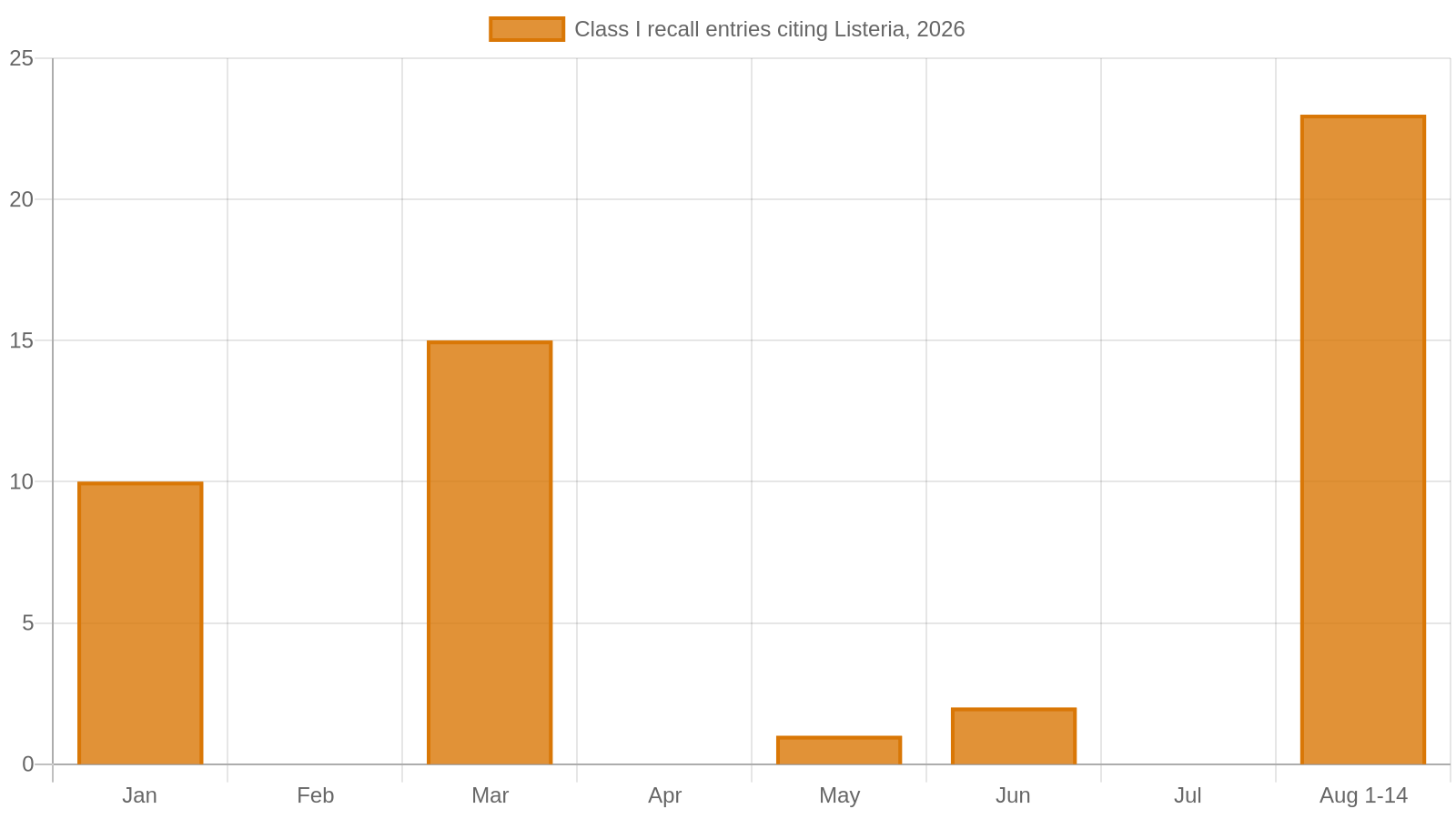
Listeria Class I counts arrive in bursts, and the bursts come from product lists more than from separate incidents. Our data shows 51 Class I entries citing Listeria from January 1 through August 14. Three companies account for 45: Clover Hill and the firms that repacked or distributed its cheese (23), Made Fresh Salads (14, in March), and Ambriola (8, in January). A cheesemaker with 18 products becomes 18 entries. Classification also lags. Clover Hill recalled in June and was classified in August, so for buyers the company announcement and FDA's outbreak page are the earlier signal.
What to watch
- GRAS comments close December 9, 2026 (Docket FDA-2025-N-3262).
- The jalapeño case count. FDA's August 5 figure was 345. Expect more downstream recalls as manufacturers check which lots they bought.
- Device and drug comment windows: the proposed reclassification of digital breast tomosynthesis systems to Class II (October 9) and the draft guidance on container closure systems for drugs and biologics (October 13).
- User fee reauthorization: public meetings on PDUFA (September 16) and GDUFA (September 17) for fiscal years 2028 through 2032.
- Kremers Urban hearing on FDA's 2016 proposal to withdraw its extended-release methylphenidate ANDA. Notices of participation are due September 14.
Policy Canary tracks every FDA action, warning letters, recalls, guidance, and rules, against the specific products you make, by name and by ingredient. See what we would flag for your products.
Get this in your inbox every Friday.
Free FDA intelligence digest. No account required.