Weekly FDA Roundup: Red No. 3's January 2027 deadline is back on, and Salmonella returns to Food to Live's green powders, August 1–7, 2026
FDA lifts the stay on its Red No. 3 ban, confirming the January 15, 2027 food deadline. Plus Food to Live's green powders, DEG testing failures, and a morphine syringe mix-up.
The most consequential document FDA published this week was not a recall. On August 5 the agency overruled the only objection to its Red No. 3 ban and lifted the stay that had frozen it since February 2025. The January 15, 2027 deadline for food and dietary supplements is now confirmed, a little over five months out. The week also brought another Salmonella recall of green powders, this one triggered by an FDA retail sample, and eight warning letters, half of them to drug manufacturers.
By the numbers
- 36 FDA actions posted August 1–7.
- 8 warning letters, all posted August 4. Four cited drug CGMP violations, and two of those were for skipping diethylene glycol (DEG) and ethylene glycol (EG) testing on glycerin.
- 3 Class I actions: unlabeled requeson (soft ricotta) over Listeria, and two convenience-kit corrections, one for Namic manifolds and one for Huons anesthetics.
- 2 approvals FDA announced: Orzeyful for narcolepsy type 1 and Tudriqev for melanoma that stopped responding to PD-1 therapy.
- Standout: Red No. 3's January 15, 2027 food deadline is confirmed.
Lead story: Red No. 3's deadline is back on
In January 2025 FDA ordered FD&C Red No. 3 removed from the color additive regulations for food, including dietary supplements, effective January 15, 2027, and for ingested drugs, effective January 18, 2028. The basis was the Delaney Clause. Red No. 3 has been shown to cause cancer in male rats, and the statute deems a color additive that induces cancer in animals unsafe for any use that results in ingestion.
One party objected. Micro-Tracers, Inc., through its counsel, raised three objections: that FDA misread the statistics in the rat data, that it ignored Red No. 3's use in color-coded tracers for medicated animal feed, and that tracers should have been exempted or given a safe tolerance level. Under the FD&C Act, filing objections automatically stays the order, and it sat frozen from February 18, 2025.
On August 5, 2026, FDA overruled all three objections, denied the hearing requests, and lifted the stay. The agency concluded the objections raised no factual issue a hearing could resolve. Both effective dates stand, and FDA called this its final action on the objections.
This is now a final, dated requirement. If you make a food or supplement colored with Red No. 3 (labels may list it as Red 3, FD&C Red No. 3, or erythrosine), you have until January 15, 2027 to reformulate and clear existing inventory. Ingested drug products have until January 18, 2028. Check every SKU's ingredient statement and ask your color suppliers to confirm in writing which blends contain it.
It also fits a pattern. In the July 23 Federal Register, FDA revoked Orange B and proposed revoking Citrus Red No. 2. Three synthetic dye actions in under two weeks looks like a deliberate sequence, and we would not bet on it stopping here.
Key developments
Salmonella turns up in Food to Live's green powders again
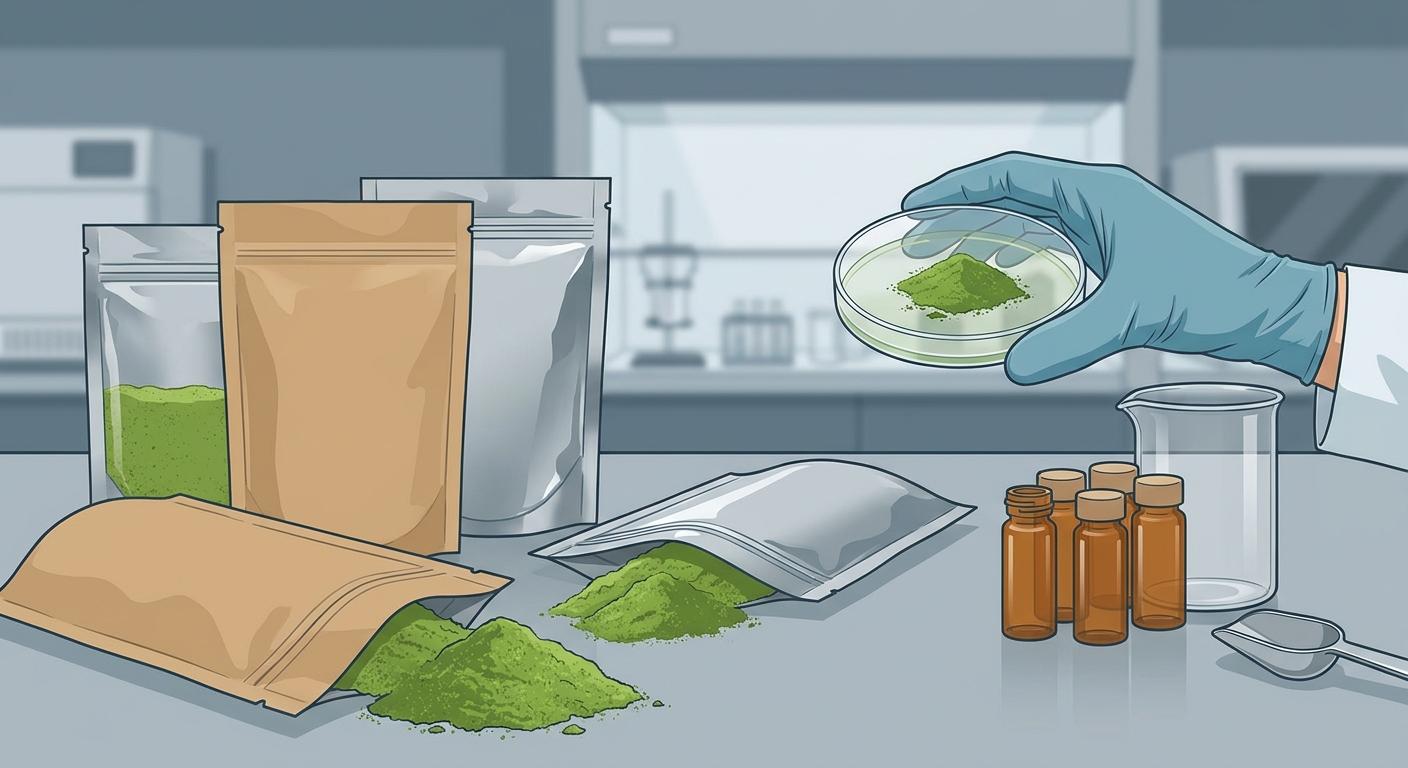
Lexunder Inc., which sells as Food To Live, recalled green powders sold nationwide through foodtolive.com, foodinbulk.com, and other online marketplaces after an FDA retail sample of its Organic Supergreens Mix tested positive for Salmonella. The recall covers spirulina, algae mix, SuperGrass, and wheatgrass powders in pouches and bulk cases of 33 to 55 pounds, lots SO-72558 through SO-79374 plus three other codes. Production and distribution are suspended, and the source has not been found. This is not the brand's first time. FDA's December 2025 enforcement report listed Class I Salmonella recalls for Food to Live's Organic Supergreens Powder Mix and Organic Moringa Leaf Powder. A 55-pound case is an ingredient for someone else's product, so if you buy greens powders in bulk online, check your lot codes against the notice today.
Two drugmakers skipped DEG testing on glycerin
Woodbine Products Company (Medina, Ohio) and Thomas Brunner Hygiene GmbH (Germany) both drew letters for not running glycerin identity tests that include the USP limit test for DEG and EG, contaminants FDA ties to lethal poisonings worldwide. Woodbine also used nonpharmaceutical-grade propylene glycol in OTC drugs. Thomas Brunner's syNeo antiperspirants combine aluminum chlorohydrate 10% and aluminum chloride 10%, a pairing the OTC antiperspirant monograph (M019) does not allow, which makes them unapproved new drugs. The sharpest letter went to Dabur India. FDA says the equipment logbook handed to its investigator was falsified, leaving out U.S.-marketed OTC products, and the original turned up in the document room. Dabur's drugs have been on Import Alert 66-40 since June 5, 2026.
Marine collagen with an undeclared fish source
Mellish Island Corp recalled 1,600 bottles of Super Skin, a dietary supplement sold exclusively through TikTok, because the label did not declare that its marine collagen came from fish (Class II). "Marine" does not tell an allergic consumer that fish is in the capsule. Two more allergen recalls came from mix-ups further down the chain. Sun Noodle found fish-containing soba sauce packed into 134 Sura Tanmen kits sold in Hawaii, and Blank Slate Creamery recalled vegan coconut fudge sandwiches made with last week's recalled Rooted in Rare aquafaba powder, which contained undeclared egg.
A morphine syringe that may hold hydromorphone
Fresenius Kabi recalled lot 6402820 of Morphine Sulfate Injection 2 mg/1 mL Simplist prefilled syringes because a package labeled morphine may contain Dilaudid (hydromorphone) 0.5 mg/0.5 mL. The company says the swap carries a reasonable probability of life-threatening respiratory depression and death, with opioid-naive and pediatric patients at greatest risk. The lot shipped nationwide between January 29 and June 9, 2026. Separately, Victory Medical Center Pharmacy in Austin recalled three lots of compounded glutathione injection for elevated endotoxin after patients reported fever, chills, and tachycardia.
The bigger picture
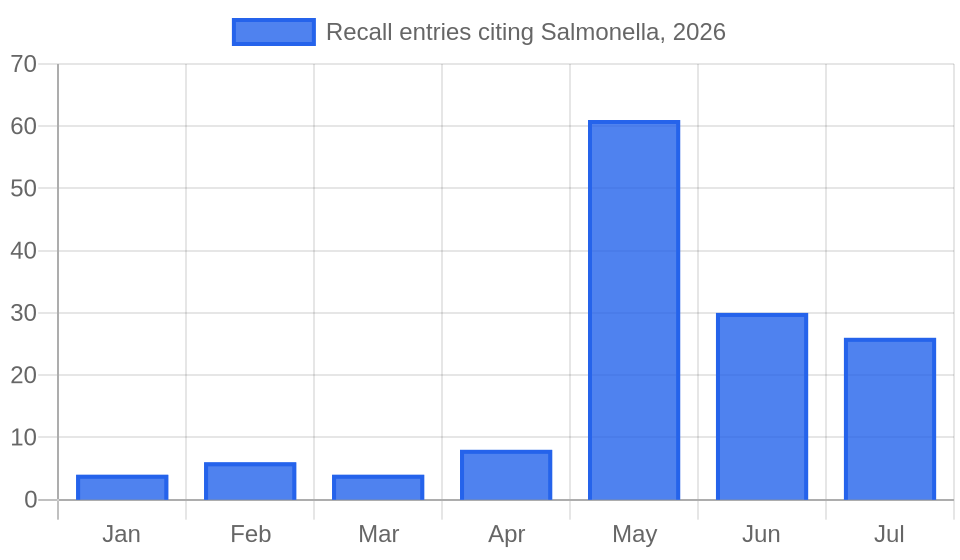
Salmonella has become the steady background of 2026 recalls. Counting FDA recall notices and enforcement entries that cite Salmonella, January through April ran 4, 6, 4, and 8. May jumped to 61, driven largely by the California Dairies milk powder cascade, and the count held at 30 in June and 26 in July. Dry, shelf-stable foods keep showing up: milk powder in the spring, moringa and greens powders all year, and this week a Bettergoods pistachio nut butter sold at Walmart in 19 states, caught by Florida state testing. Since November 2025 our records hold 22 moringa-linked Salmonella recall entries from 12 companies. Powders usually go into a smoothie or capsule without a cooking step, so a contaminated lot goes straight to the consumer. Test finished lots yourself rather than relying on a supplier certificate.
What to watch
- Red No. 3 deadlines: January 15, 2027 for food and supplements, January 18, 2028 for ingested drugs. FDA calls this its final action on the objections, so plan reformulation and sell-through now.
- BD intraosseous needles. FDA posted an Early Alert on August 4 for the recall we led with last week, citing 45 serious injuries and four deaths as of July 22. A formal classification should follow.
- Orzeyful's launch waits on DEA. Takeda's twice-daily orexin agonist can be marketed only after DEA issues its scheduling decision.
- Comment deadlines on October 2, 2026 for FDA's draft guidance on biosimilar container closure systems and its revised draft guidance on irritation and sensitization testing for generic transdermal systems.
- Food to Live's investigation. The contamination source is still unknown, so the lot range could change.
Policy Canary tracks every FDA action, warning letters, recalls, guidance, and rules, against the specific products you make, by name and by ingredient. See what we would flag for your products.
Get this in your inbox every Friday.
Free FDA intelligence digest. No account required.