Weekly FDA Roundup: Taylor Farms pulls all its Mexican iceberg lettuce, a recalled anesthetic keeps surfacing in surgical kits, and 13 warning letters land in a day, July 11–17, 2026
A Cyclospora outbreak forced Taylor Farms to recall every head of Central Mexico iceberg across 27 states, while a recalled Huons anesthetic pulled two more surgical kit lines off the market.

The week ended with a produce recall large enough to reach 27 states. On July 17 Taylor Fresh Foods pulled every head of iceberg lettuce it sourced from Central Mexico, tied to a multi-state Cyclospora outbreak that federal and state health officials were still investigating. Behind that headline sat a quieter pattern worth more of your attention: eight Class I recalls, every one of them in food and supplements, and a recalled anesthetic that keeps turning up inside surgical convenience kits.
By the numbers
- 51 FDA actions posted July 11 through 17.
- 13 warning letters, all dated July 14.
- 8 Class I recalls, every one in food or dietary supplements.
- 2 Class I device convenience-kit recalls built on the same recalled Huons anesthetic. B. Braun's recall alone follows 35 reported serious injuries.
- Standout: Taylor Fresh Foods recalling all Central Mexico iceberg lettuce across 27 states.
Lead story: Taylor Farms pulls all its Mexican iceberg lettuce as a Cyclospora outbreak spreads
On July 17 Taylor Fresh Foods (Taylor Farms de Mexico) recalled all iceberg lettuce sourced from Central Mexico over potential Cyclospora contamination. This was not a single lot or a single label. The recall swept up numerous food service and retail brands, including CV, JB, Mark, MKTSD, PK, SUB, SY, and TF, distributed across 27 U.S. states. The affected product shipped between June 29 and July 16, with "Best if Used By" dates running into the following weeks.
The recall is linked to an active multi-state outbreak investigation by CDC, FDA, and state health departments. Cyclospora is a parasite that causes prolonged, relapsing diarrheal illness, and it is stubborn: it does not respond to the chlorine washes that kill most bacteria on leafy greens, so contaminated lettuce cannot be made safe at the processing step. That is why the response here is to remove the product rather than reprocess it.
What makes this one matter beyond the produce aisle is reach. Iceberg from a single growing region flows into sandwiches, salad kits, and restaurant supply chains under names that share nothing on the shelf. A restaurant operator or a packaged-salad maker may be holding recalled lettuce without recognizing any of the eight brand codes in the notice. As of July 17 the source had not been confirmed by a positive product test, and the case rested on traceback and patient interviews, so anyone downstream of Central Mexico iceberg should treat the region, not just the brand, as the trigger to pull inventory.
Key developments
The same recalled anesthetic keeps pulling surgical kits off the market
Two more convenience-kit actions landed this week, both built around Huons-manufactured injectable anesthetics that were already recalled. On July 16 B. Braun Medical recalled its PENCAN and Spinocan spinal anesthesia kits because they contained Huons Bupivacaine Hydrochloride in Dextrose Injection. FDA classified it Class I after 35 reported serious injuries and no deaths. The risks in the neuraxial space include infection, reduced anesthetic effectiveness, and meningitis. The same day, Arrow International issued a Class I correction for convenience kits containing recalled Huons lidocaine, bupivacaine, and saline, telling providers to discard the affected ampules at the point of use and swap in pharmacy stock. This is the pattern to note: the defect sits in one supplier's component, and it surfaces again each time a different kit maker discovers the Huons product buried in its bill of materials.
Adams Extract's sesame problem hit five products at once
Adams Extract & Spice recalled five products on July 15, four of them Class I, all for undeclared sesame. The Class I items were JB Chicken Sknls, EC Hot Links Seasoning, Smoked Sausage Spice, and the Coopers BBQ 60 Gallon Bean Mix, with a fifth product, Johnny's Salad and Pasta Elegance, recalled at Class II. Sesame became the ninth major allergen requiring declaration under the FASTER Act, and enforcement has been steady since. What makes a spice-house recall spread is position in the chain. Seasoning blends and bean mixes are ingredients, so an undeclared allergen in a 45-pound bag of hot-link seasoning can travel into far more finished products than the label count suggests.
Thirteen warning letters in a day, weighted toward imports and tobacco
All 13 warning letters this week posted on July 14. Four cited Foreign Supplier Verification Program failures (Diamond Distributions, Win Woo Trading / HF Foods Group, Full Fresh Produce, and J&B Food Consulting), and AF Import & Wholesale drew a seafood HACCP and insanitary-conditions letter. Two went to overseas vape and nicotine sellers, eliquidflavourconcentrates.co.uk and snusblast.co.uk, under the Tobacco Control Act. The rest spanned sectors: Nutratech for dietary supplement CGMP violations and an undeclared allergen, Nihon Kohden for marketing NetKonnect software without 510(k) clearance after adding a "Silence Alarms" function, ZIIP for device CGMP problems, and International Medication Systems and Spa De Soleil for finished-pharmaceutical CGMP violations.
Device recalls stacked up alongside the anesthetic kits
Beyond the Huons kits, three more device actions posted. Medtronic recalled certain lots of its Harmony Delivery Catheter System over a risk of distal tip detachment during pulmonary valve implantation, a failure that can require surgical retrieval. Abiomed recalled its 14Fr Low Profile Introducer Kits and compatible Impella CP sets after three reported serious injuries from thrombus formation that can cause vascular occlusion. Baxter issued a correction for its Volera positive-pressure breathing device, and FDA published an early alert on a Resmed ventilator issue. None reached the injury count of the B. Braun recall, but the concentration of vascular and respiratory device actions in one week is the kind of clustering worth tracking.
On the approvals and guidance side, cholesterol and psychedelics
FDA approved Lipfendra (enlicitide) on July 17, the first oral PCSK9 inhibitor, a once-daily tablet to lower LDL cholesterol in adults, including those with heterozygous familial hypercholesterolemia. On July 14 the agency finalized its guidance on clinical investigations of psychedelic drugs, covering trial design and safety, and paired it with a notice for a public hearing on potential future therapeutic use. FDA also issued an Emergency Use Authorization for Alberta Vet Labs' ivermectin oral solution to protect newborn and wounded horses against New World screwworm.
The bigger picture
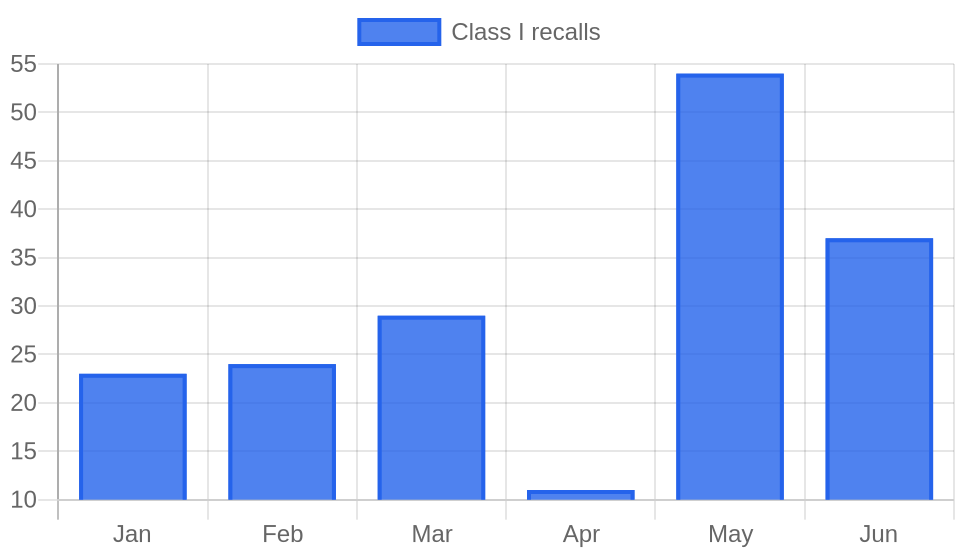
Class I recalls have been running hot all year, and food keeps driving the volume. After a comparatively quiet April, the monthly count spiked in May and stayed elevated through June. This week's eight Class I recalls, all in food and supplements, fit that upper band rather than breaking from it. The recurring thread here is allergens and pathogens in the ingredient layer: undeclared sesame in seasoning blends, Salmonella in moringa powder and in mispacked chicken, Cyclospora in a single growing region's lettuce. When the problem sits upstream, one recall rarely stays one recall.
What to watch
- Whether the Cyclospora traceback confirms a source and expands the Taylor Farms recall to more brands or states.
- More kit makers finding recalled Huons anesthetic components in their bills of materials, extending this Class I thread another week.
- The proposed rule on drug establishment registration and listing for distributed manufacturing and certain foreign establishments, published July 13.
- A batch of FDA information-collection notices (infant formula, adverse event reporting, medical devices, accreditation) open for comment through September 15, 2026.
Policy Canary tracks every FDA action, warning letters, recalls, guidance, and rules, against the specific products you make, by name and by ingredient. See what we would flag for your products.
Get this in your inbox every Friday.
Free FDA intelligence digest. No account required.