Weekly FDA Roundup: seven million insulin pods recalled, a wave of Salmonella food recalls, and ten warning letters, June 27–July 3, 2026
FDA's most serious actions this week were four Class I device recalls, led by roughly 7 million Insulet Omnipod insulin pods, alongside a cluster of Class I food recalls and ten warning letters.

The most serious FDA actions this week were not approvals or new rules. They were four medical device recalls, each in the agency's most serious category, touching a heart pump, an insulin pump, a ventilator breathing circuit, and a surgical tissue marker. The insulin pump recall alone reaches roughly 7 million pods.
By the numbers
- 77 FDA actions tracked June 27 through July 3.
- 10 warning letters, all posted June 30, spanning dietary supplements, animal drugs, medical devices, finished pharmaceuticals, biologics, and an API maker that refused FDA access to its records.
- 4 Class I medical device recalls: Insulet Omnipod pods, Abiomed Impella CP heart pumps, Hamilton Medical breathing circuits, and Hologic BioZorb markers.
- 25 Class I food recall listings from five companies, on causes ranging from Salmonella to undeclared allergens to botulism risk.
- 1 notable approval: Casgevy, the first gene therapy cleared for young children with sickle cell disease.
Lead story: a Class I recall reaches seven million insulin pods
On July 2, FDA confirmed a Class I classification for Insulet's correction of certain Omnipod insulin pods, the agency's most serious recall level. The defect is a small tear in the cannula, the thin tube that carries insulin from the pod into the body, just above the skin. When the tube tears, insulin leaks inside the pod instead of reaching the patient, and the result is under-delivery of insulin. Insulet reported 24 serious injuries and no deaths as of May 20.
What makes this recall serious is not only the injury count but the reach and the silence of the failure. The correction covers all three generations of the pod platform: the Omnipod 5 automated system, the previous Omnipod DASH, and the original Omnipod Eros. Insulet has said roughly 7 million pods are affected. In many cases the tear produces no alarm, so a patient can receive too little insulin without any warning from the device. Prolonged under-delivery can lead to diabetic ketoacidosis, a life-threatening condition.
FDA first flagged the problem in an Early Alert on June 4, then updated the communication on July 2 to confirm the Class I designation. Anyone using an affected-lot pod is told to stop using it and change to a new pod immediately to resume insulin delivery. Because the three affected systems are among the most widely used insulin delivery products in the United States, the population exposed to this defect is large, and the fix depends on individual patients checking their lot numbers. Clinicians managing insulin-dependent patients should confirm which pods their patients are wearing.
Key developments
A heart pump recall with a reported death
FDA classified Abiomed's removal of seven Impella CP Sets with SmartAssist as a Class I recall on July 2. The affected sets may not meet design specifications and can produce low purge pressure alarms from the start of a case, which risks interruption or loss of heart pump support. That failure can cause hypotension, end-organ hypoperfusion, and death if not corrected quickly. Abiomed reported one death and three pump exchanges tied to the issue. A review of global complaints from January 2024 through April 2026 found the problem in 12 of 107,277 cases, a rate of 0.01 percent. The Impella CP with SmartAssist is a temporary heart pump used during high-risk coronary procedures and to treat patients in cardiogenic shock, so the patients exposed are already critically ill.
A wave of Class I food recalls, from Salmonella to botulism risk
July 1 brought 25 Class I food recall listings from five companies, each with a different root cause. Utz Quality Foods recalled multiple Dirty and Zapp's chip products over potential Salmonella contamination. Spring & Mulberry recalled 13 varieties of its date-sweetened chocolate, also for Salmonella, distributed through wholesale, retail, and Amazon. George J Howe Company recalled a range of sunflower seed products over an undeclared cashew allergen. CERELES en General, packing Pearl Milling Company Original Pancake and Waffle Mix, recalled it for undeclared milk and soy. Prime Food Processing recalled 7 oz dried herring because improper evisceration created a risk of Clostridium botulinum. Five companies, five distinct problems, one day.
Ten warning letters, from biologics to supplements
FDA posted 10 warning letters on June 30. Genzyme Ireland Limited drew one for CGMP violations in the manufacture of its licensed biologics Thymoglobulin and Altuviiio, including data integrity failures and incomplete laboratory records after a January 2026 inspection. Flax & More Corporation was cited for supplement CGMP violations at its Cutler Bay, Florida facility, including residue on a hopper used for a wheat-bran product. The rest span medical devices (BMC Medical, 3B Medical, AseptiKits), finished pharmaceuticals (Excelvision-Fareva, Wizcure Pharma), a new animal drug (Golden Dakota Farms), a food importer's failure to verify foreign suppliers (Life & Food), and an API maker, Yangzhou Hongshengding Chemical, that refused to let FDA access and copy its records.
A tissue marker recall with 252 reported injuries
Hologic is recalling all unused lots of its BioZorb and BioZorb LP markers, and FDA classified the action as Class I on June 30. The agency cited 252 reported injuries, including device migration, erosion through the skin, pain, infection, and seroma. FDA noted the marker was never cleared for cosmetic tissue filling or radiation marking and told providers to stop implanting the devices immediately. BioZorb has drawn FDA scrutiny before, and a full removal of unused stock closes a thread that has been developing for more than a year.
On the approval side, a first for pediatric sickle cell
Not every action this week was a recall. FDA granted supplemental approval for Casgevy in children aged 2 and older with sickle cell disease or transfusion-dependent beta thalassemia, the first gene therapy cleared for this younger age group. Casgevy uses CRISPR to edit a patient's own blood stem cells to raise fetal hemoglobin. FDA also proposed a rule requiring establishment registration and product listing for tobacco products, and approved a new cell therapy that uses donor immune cells to prevent serious complications after blood cancer treatment.
The bigger picture
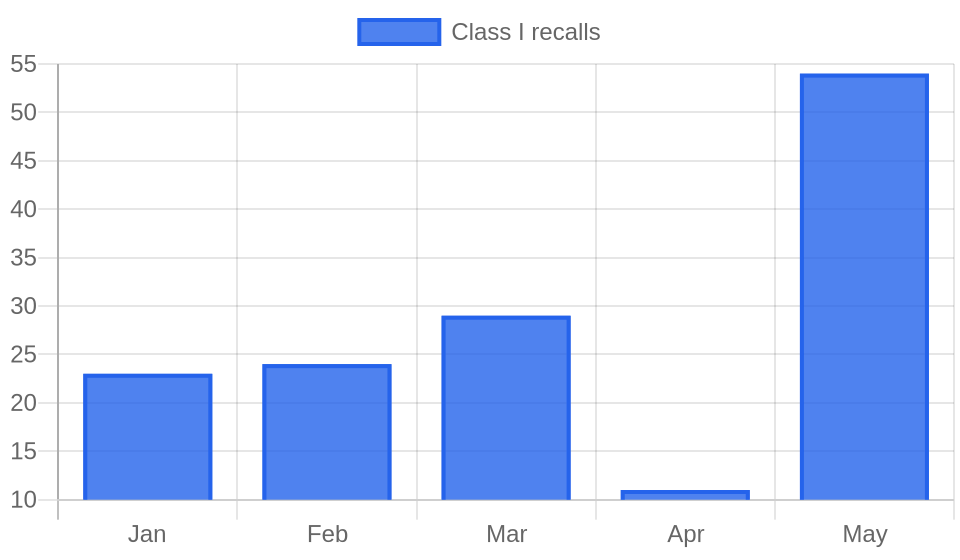
Four Class I device recalls in a single week is a heavy count, and it lands during a year in which Class I recalls have been running hot. May recorded 54 Class I recalls, more than double the January total and the highest month so far in 2026. This week extends that pattern into the device aisle, where the failures were not exotic. A torn cannula, a purge pressure alarm, an expiratory valve that sticks, a marker that migrates. Common components failing in devices patients depend on to breathe, dose insulin, or maintain circulation.
What to watch
- Insulet Omnipod: whether the affected-lot list expands beyond current lots, and how quickly patients replace pods.
- Abiomed Impella: this is one recall in a longer string of Impella corrections; watch for additional lots or components.
- VYALEV patent extension: the regulatory review period determination is open for comment through December 28, 2026.
- Tobacco registration: the proposed rule on establishment registration and product listing opens a comment period industry should track.
- Two OMB information collection notices: comment deadlines fall on July 29 and July 31.
Policy Canary tracks every FDA action, warning letters, recalls, guidance, and rules, against the specific products you make, by name and by ingredient. See what we would flag for your products.
Get this in your inbox every Friday.
Free FDA intelligence digest. No account required.