Weekly FDA Roundup: 25 telehealth GLP-1 warning letters, an infant formula botulism recall, and four Class I food recalls, June 13-19, 2026
FDA posted 25 warning letters to telehealth firms selling compounded GLP-1 drugs in one day, plus four Class I food recalls and an all-lots infant formula recall tied to infant botulism.

The single biggest thing FDA did this week arrived as a stack of nearly identical letters. On June 16 the agency posted 25 warning letters to telehealth companies in one day, every one of them marketing compounded semaglutide or tirzepatide, every one accused of telling customers online that these compounded weight-loss drugs are FDA-approved when they are not. One warning letter is a company's problem. Twenty-five on a single day is a market getting put on notice.
By the numbers
- More than 90 FDA actions logged for the week of June 13 to 19, spanning warning letters, recalls, safety alerts, guidance, and rules.
- 33 warning letters, of which 25 went to telehealth companies over compounded GLP-1 marketing claims, all posted June 16.
- 4 Class I food and supplement recalls (Listeria, Salmonella, undeclared shrimp, undeclared egg), plus a separate Class I recall of Draeger anesthesia workstations.
- Standout item: NARA Organics recalled all lots of its infant formula after three infants were hospitalized with botulism.
Lead story: FDA hits 25 telehealth weight-loss sellers in a single day
The compounded GLP-1 boom has been running ahead of the rules for two years, and on June 16 FDA moved to close the gap. The agency posted 25 warning letters to telehealth firms marketing compounded semaglutide and tirzepatide, the active ingredients in Ozempic, Wegovy, Mounjaro, and Zepbound. The companies span the industry, from well-funded brands like Maximus Health, Ezra, and Joi + Blokes to smaller operators like Ready Med, NativeMed, and Altru Telehealth.
The violations repeat from letter to letter. FDA says Maximus Health claimed its sourcing pharmacies were FDA-approved and that its compounded drugs had proven weight-loss efficacy. Amie Health went further, per the agency, suggesting it was the compounder itself and that its compounded product was FDA-approved. Compounded drugs are not FDA-approved. The agency does not review them for safety, effectiveness, or quality before they reach a patient, and marketing that blurs that line is what drew the letters.
This is not FDA's first pass at the problem. Late in 2025 the agency sent more than 40 similar letters to telehealth compounders over the same claims. June's round is smaller but pointed, and it lands after the drug shortages that once made large-scale GLP-1 compounding permissible have largely eased, which narrows the legal ground these firms stand on. Each company has 15 business days to respond. Anyone selling, prescribing, or marketing a compounded GLP-1 should read the 25 letters as a template for what FDA will cite next.
Key developments
An infant formula recall over botulism is the week's most serious food safety signal
On June 13 NARA Organics recalled all lots of its Whole Milk Powdered Infant Formula, sold in 400g and 700g sizes, over possible Clostridium botulinum contamination. The recall followed a joint FDA and CDC report of three infants hospitalized with infant botulism after consuming the product. As of the recall the formula had not tested positive for the pathogen, and NARA pulled every lot out of caution. Infant botulism is a serious, potentially life-threatening illness, and powdered formula recalls carry weight because caregivers stockpile the product and feed it daily to the most vulnerable patients FDA regulates. Parents holding NARA formula should stop using it and contact their pediatrician.
Draeger's anesthesia machines can stop ventilating mid-procedure
Draeger issued a Class I recall for its Atlan A350 and A350XL anesthesia workstations over a manufacturing defect in the ventilator motor assembly. The defect can cause automatic mechanical ventilation to fail before or during a procedure, which risks hypoxia, cardiac arrest, or death. Manual ventilation remains possible, so FDA is not telling hospitals to stop using the machines, but the agency warns that affected units must run under close, constant supervision until Draeger replaces the ventilator motor assembly. For an anesthesia machine, a ventilator that can quit without warning is close to a worst-case failure mode, which is why this correction carries FDA's most serious recall classification.
Four Class I food and supplement recalls, four different failures
Alongside the formula recall, four products drew Class I designations, FDA's most serious recall category, for four unrelated reasons. HH Fresh Trading recalled 150g Enoki Mushrooms grown in Taiwan after they tested positive for Listeria monocytogenes. Total Nutrition recalled TNVitamins and Doctor's Pride Moringa capsules over possible Salmonella. Kettle Cuisine recalled Whole Foods Market Kitchens Minestrone Soup because the 24 oz cups contain undeclared shrimp despite a "vegetarian" label, a combination that endangers both shellfish-allergic and vegetarian buyers. E & S Grocery & Bakery recalled Taro Cakes for undeclared egg. Three of the four are the mundane failures, an allergen left off the label or a pathogen in produce, that still put people in the hospital.
The convenience-kit problem surfaces again
Two device early alerts this week point back at the same weak spot we have flagged before: kits assembled from components made by someone else. Windstone Medical Packaging, operating as Aligned Medical Solutions, issued a recall and over-labeling instruction for its DSAEK Pack, Thyroid FNA Pack, Preop Kit, and Dr. Lewin Pack, all of which contain Cardinal Health Webcol alcohol prep pads that may carry Paenibacillus phoenicis, a contamination risk that hits immunocompromised and pediatric patients hardest. Separately, FDA flagged 14Fr and 23Fr introducer kits made by Oscor for use with Abiomed Impella heart pumps, where leakage from the sidearm and hub can cause access-site bleeding or life-threatening hemorrhage. Different kits, different parts, same lesson about component sourcing.
ZOLL Medical drew a wide-ranging device manufacturing warning
FDA sent ZOLL Medical a warning letter citing severe CGMP and quality-system violations across a broad device portfolio, including automated external defibrillators, MRI-compatible ventilators, electrodes, and sensors. Inspectors found the company failed to establish proper corrective-and-preventive-action procedures, validate design changes for MRI compatibility, analyze risk effectively, and control supplier quality. For a maker of AEDs and ventilators, quality-system gaps at the manufacturing level reach a lot of critical-care equipment at once.
The bigger picture
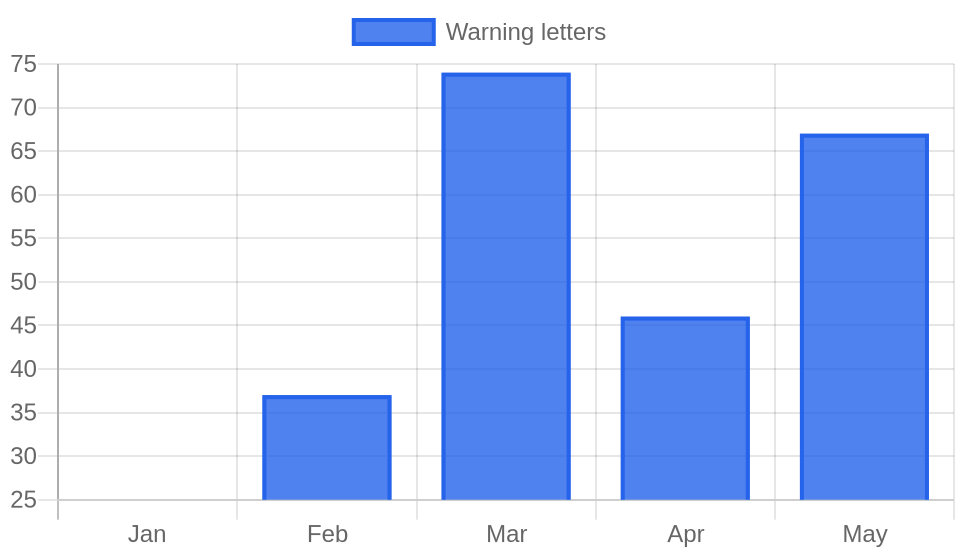
The 25 telehealth letters did not land in a quiet stretch. FDA warning-letter volume has run elevated all year, and enforcement against compounded GLP-1 marketing has been a repeated theme since the 40-plus letters of late 2025. The monthly warning-letter counts below show the cadence FDA has kept through the first five months of 2026, with March and May both clearing 60. June's telehealth sweep fits a pattern of the agency working through advertising claims in batches rather than one company at a time.
What to watch
- The 25 telehealth firms have 15 business days from June 16 to respond. Expect a follow-up wave, and possibly seizures or injunctions, for any that do not correct their claims.
- Stereotactic breast biopsy needles remain in shortage until roughly March 2027, driven by Hologic's removal of all Brevera 9-gauge disposable needle lots over particulate contamination. Providers should plan conservation now.
- Comments on FDA's draft guidance for Forms 3542a and 3542 (patent submission questions and answers) are due August 14, and comments on the extralabel drug use information collection are due August 17.
- Whether the compounded GLP-1 sweep widens. The late-2025 round topped 40 letters; this round is 25, and the shrinking shortage list gives FDA more room to escalate.
Policy Canary tracks every FDA action, warning letters, recalls, guidance, and rules, against the specific products you make, by name and by ingredient. See what we would flag for your products.
Get this in your inbox every Friday.
Free FDA intelligence digest. No account required.