Weekly FDA Roundup: a milk powder cascade drives eight Class I recalls, eleven warning letters land in a day, and FDA moves to speed gene therapies, May 30–June 5, 2026
Eight Class I recalls hit this week, most tracing to one Salmonella-contaminated milk powder or a milk allergen. FDA also posted eleven warning letters in a single day.

The most consequential FDA action this week was not signed by FDA. It was a bag of powdered milk. Eight of the week's recalls carried the agency's Class I label, its most serious tier, and most of them trace back to a single contaminated ingredient or a single mislabeled allergen. When one supplier's product goes bad, the recalls surface for months afterward in brands that never knew they were exposed.
By the numbers
- 58 tracked FDA actions across food, drugs, devices, supplements, and animal health for May 30 through June 5.
- 11 warning letters, all posted June 2, spanning bakeries, seafood importers, an OTC drug plant, and a supplement maker.
- 8 Class I recalls: four from Wawa Beverage Company, three from Legacy Bakehouse, and one from Honeyville.
- 3 public safety alerts for tainted supplements sold online, each hiding a prescription drug.
- 11 device and animal-drug classification rules published in the Federal Register.
Lead story: one recalled ingredient keeps pulling food off shelves
Legacy Bakehouse issued three Class I recalls on June 3, all for the same reason. Its Giant Eagle Baked Pita Chips, Butter Parsley Bagel Crisps, and Parmesan and Herb Bagel Crisps were made with powdered milk from California Dairies Inc. that had already been recalled for potential Salmonella contamination. The Butter Parsley lot covered 750 cases and the Parmesan and Herb lot covered 588 cases, with production dates running from January 29 to April 12, 2026.
The upstream event is large. California Dairies recalled roughly 2.7 million pounds of nonfat dry milk and about 19,841 pounds of buttermilk powder on April 20, 2026. That powder went into a lot of finished products, and the downstream recalls have kept coming. As of this week the cascade had grown to more than 40 food products from multiple manufacturers, sold at Costco, Kroger, Publix, Target, and Walmart, making it one of the most expansive food recall events of the year.
Why it matters: the lag between the ingredient recall and the finished-product recall is measured in weeks, sometimes longer. A bakery using powdered dairy in January had no way to know in April that the ingredient was suspect. Anyone who buys powdered milk, whey, or buttermilk as an input should be checking supplier lot numbers against the California Dairies recall now, not waiting for their own product to appear on the FDA's Class I list. Honeyville's Class I recall of a bulk banana smoothie tote the same day, also tied to a Salmonella-contaminated ingredient, is the same pattern in a different aisle.
Key developments
Wawa's iced tea and lemonade reach the most serious recall tier
FDA posted Class I classifications on June 3 for four Wawa Beverage Company products: 16 ounce Iced Tea Lemon, Iced Tea Diet Lemon, Diet Lemonade, and Fruit Punch. The cause here is not a pathogen but undeclared milk, introduced by a temporary equipment issue during production. Wawa initiated the recall on April 3 for products sold in Pennsylvania, Delaware, Maryland, New Jersey, and Virginia, and no illnesses have been reported. The Class I label reflects the real danger to milk-allergic consumers, for whom undeclared milk in a lemonade is exactly the failure that allergen labeling exists to catch. Two milk stories, one an allergen and one a pathogen, landed in the same week and both earned the top severity tier.
Eleven warning letters in a single day
FDA posted 11 warning letters on June 2, and the spread shows how wide the agency casts. Laboratorios Jaloma, a Mexican OTC drug facility, was cited for falsifying microbiological data, using unvalidated test methods, and weak computer controls; its drugs are now on import alert. Aversa's Italian Bakery drew a letter for allergen cross-contact that put sesame in steak rolls plus undeclared milk and soy. Stavis Seafoods and City Market were cited for seafood HACCP failures, Boba Factory for foreign supplier verification, Medline for finished-pharmaceutical CGMP, and Meta Labs Pharmaceuticals for selling a dietary supplement as an unapproved new drug. The Jaloma data falsification is the standout, because fabricated lab records undermine every other quality claim a plant makes.
Three tainted supplements, the same hidden drugs
FDA warned consumers away from three products on June 4, each sold on eBay and other retail sites and each spiked with an undeclared prescription active. Juicy AF!, marketed for female sexual enhancement, contains sildenafil, dangerous for anyone taking nitrates. FATZorb, a weight-loss product, tested positive for sibutramine, two sibutramine analogs, and phenolphthalein. Lipofit Extreme 2.0, another fat burner, also hid drug ingredients. Sibutramine was pulled from the US market in 2010 over cardiovascular risk, and it keeps reappearing in weight-loss products sold online. This is a recurring FDA beat rather than a new one, and the pattern (sexual enhancement and weight loss are the two categories that draw these alerts) has not changed.
Device early alerts keep stacking up
The week brought a run of device safety actions short of formal recall classification. Abiomed is recalling 14Fr Low Profile Introducer Kits and an Impella CP set over higher-than-expected thrombus formation during prolonged use, which can cause vascular occlusion. GE HealthCare issued an early alert for Giraffe and Panda infant resuscitation systems whose loose blender knob shaft can deliver the wrong oxygen concentration and cause hypoxia or hyperoxia in infants, plus a separate correction for certain anesthesia Carestations. Becton Dickinson issued a correction for BD spinal trays. Early alerts like these usually precede formal Class I classification, so expect some of these to return on the recall list.
FDA moves to speed cell and gene therapies
Against a week heavy with enforcement, FDA pushed a forward-looking draft guidance on June 2 aimed at accelerating human gene therapy development. It lays out how sponsors of genome-editing somatic cell therapies can lean on existing chemistry, manufacturing, nonclinical, and clinical data from prior platforms instead of repeating established work. Comments are open through August 31. For developers in the cell and gene space, the message is that FDA wants to cut duplicated submissions, which is the kind of signal worth reading closely before the next filing.
The bigger picture
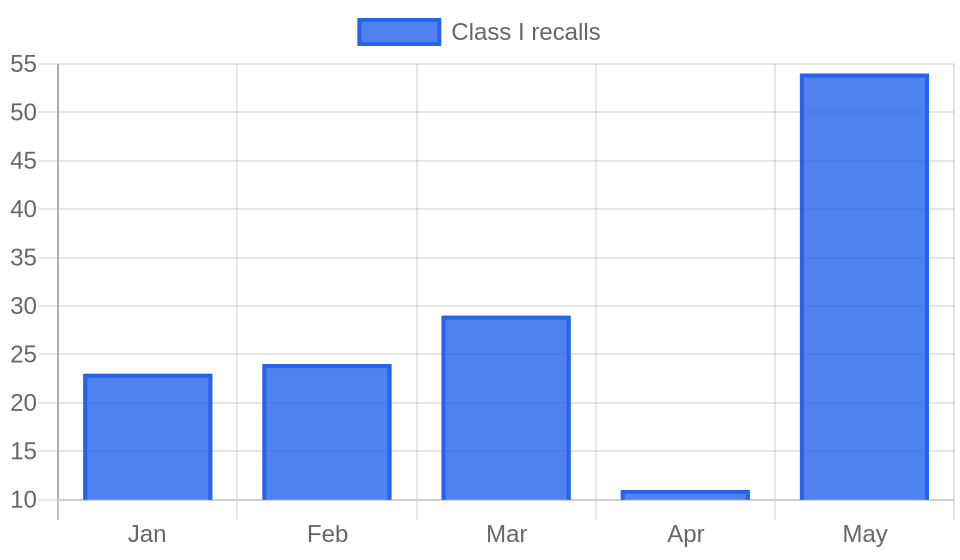
This week is a clean illustration of how modern food recalls propagate. A contamination event at one ingredient supplier does not produce one recall; it produces a slow drip of Class I recalls across every brand that bought the ingredient. The May Class I count reflects that dynamic. The agency logged 54 Class I recalls in May, well above every earlier month this year, and the California Dairies cascade is a large part of the jump. The story is not over, because more than 40 products are already implicated and traceability reviews keep finding new lots.
What to watch
- The California Dairies milk powder cascade should keep expanding. Manufacturers using powdered dairy should verify supplier lots now rather than wait for their own Class I recall.
- Total Nutrition expanded its Salmonella recall of moringa capsules this week after a traceability review flagged a shared raw material. Expect similar expansions as reviews continue.
- Comments on the cell and gene therapy draft guidance close August 31. The oncology streamlined nonclinical studies guidance closes July 31, and the payor communications guidance closes August 3.
- The Abiomed and GE HealthCare early alerts typically precede formal Class I classification. Track whether they convert.
Policy Canary tracks every FDA action, warning letters, recalls, guidance, and rules, against the specific products you make, by name and by ingredient. See what we would flag for your products.
Get this in your inbox every Friday.
Free FDA intelligence digest. No account required.