Weekly FDA Roundup: one milk powder triggers a Class I cascade, Raw Farm's E. coli cheddar returns, and FDA reopens BHT, May 9–15, 2026
A single Salmonella-tainted milk powder from California Dairies drove a wave of Class I recalls across Griffith Foods, Chick-fil-A, and Costco suppliers, while Raw Farm's E. coli cheddar returned.

One recalled ingredient did most of the damage this week. FDA logged 132 new enforcement and regulatory actions between May 9 and May 15, and 13 of them carried the Class I label, the agency's most serious category. Six of those thirteen trace back to the same sack of powder: nonfat dry milk from California Dairies Inc., now working its way through the food supply one downstream manufacturer at a time.
By the numbers
- 132 total FDA actions logged for the week
- 14 warning letters, all posted May 12, spanning drugs, food, tobacco, devices, and animal drugs
- 13 Class I recalls, 63 Class II, 7 Class III
- 6 of the Class I recalls tie directly to one contaminated nonfat dry milk supply
- 5 more Class I recalls are Raw Farm raw cheddar, linked to a multistate E. coli outbreak
- 2 Class I device actions for the recurring Namic syringe, plus an early alert on Draeger anesthesia machines
Lead story: one contaminated milk powder keeps multiplying into new recalls
In late April, California Dairies Inc., a Visalia cooperative, recalled roughly 2.68 million pounds of low heat nonfat dry milk and about 19,800 pounds of buttermilk powder over potential Salmonella contamination. Nonfat dry milk is a workhorse ingredient. It goes into seasonings and coatings as a carrier, into baking and beverage mixes as a functional ingredient, and into dozens of products that never mention milk on the front of the package. That is why the fallout keeps arriving in waves rather than all at once.
This week the wave reached our feed as a run of Class I recalls posted May 13. Griffith Foods pulled three separate products built on the recalled milk: Meatloaf Seasoning supplied to Costco service delis, a Milk Wash packed exclusively for Chick-fil-A, and a 50 lb Milk-N-Egg Mix. California Dairies' own powder was recalled under multiple grade labels in 25 kg bags and 2,200 lb totes, alongside its buttermilk powder. Givaudan Flavors recalled a bulk cheese-sauce seasoning for Salmonella the same day.
Salmonella in a dry dairy ingredient does not stay in one product. A single lot fans out across brands and retailers, which is exactly what happened here. Per FDA, the recall has now expanded past 40 finished products sold at Costco, Kroger, Publix, Target, and Walmart. Anyone who buys dairy powder as an input, or sells a product that contains it, should be checking supplier lot numbers this week rather than next.
Key developments
Raw Farm's raw cheddar is back on the recall list
Five of the thirteen Class I recalls on May 13 were Raw Farm LLC raw cheddar, covering the shredded, block, original, and jalapeno versions, all linked to a multistate outbreak of E. coli O157:H7. As of FDA's last update, the outbreak counted nine illnesses across California, Texas, and Florida between September 2025 and February 2026, with three hospitalizations and one case of hemolytic uremic syndrome. More than half the patients were children under five. The Fresno producer resisted FDA's recall advice for weeks before issuing a limited recall in early April, and this week's action widens it. Raw Farm is a repeat name here. The same raw cheddar was tied to an E. coli O157:H7 outbreak in early 2024. A raw-milk product built to skip pasteurization keeps producing the same pathogen.
The same Namic syringe keeps pulling kits off the market
Two more Class I convenience-kit recalls landed this week, from Aligned Medical Solutions and AVID Medical. Both involve kits built around Medline Namic Angiographic Control Syringes with rotating adaptors. The adaptor can unwind during use and loosen or fully disconnect from the manifold, which risks air embolism, significant blood loss, infection, and biohazard exposure. FDA cites four serious injuries. We flagged this exact component in our April roundup, when other kit makers recalled products over the same defect. A month later it is still surfacing in kits from new assemblers, which points to a component problem upstream rather than an assembly error at any one shop.
FDA finalizes its food-chemical program and reopens BHT
On May 12 FDA finalized its Enhanced Systematic Process for Post-Market Assessment of Chemicals in Food, along with a prioritization tool, and immediately opened reassessments of two long-approved additives. BHT is an antioxidant used across fats, oils, cereals, and meat products. ADA, azodicarbonamide, works as a dough conditioner and whitening agent and appears in some food-contact materials. Manufacturers have until July 13, 2026 to submit safety and use data. The mechanism matters more than either chemical. FDA is signaling that it intends to revisit additives that have sat on the approved list for decades, and it is starting with two that are used in enormous volume.
An anesthesia machine that may stop breathing for the patient
FDA issued an early alert on May 15 for Draeger's Atlan A350 and A350 XL anesthesia workstations. A manufacturing error in the piston ventilator motor assembly may cause mechanical ventilation to fail before or during use. Manual ventilation remains possible, but a mid-procedure failure of mechanical ventilation can lead to hypoxia, bradycardia, and cardiac arrest. Draeger is expanding an earlier correction and will replace the ventilator motor assembly on all affected units. Until that happens, affected machines carry use restrictions, and any facility running an Atlan workstation should confirm whether its serial numbers are in scope.
Glass particles in a chemotherapy drug
Sun Pharmaceutical Industries issued a nationwide voluntary recall of one batch (Lot HAG2581B) of Doxorubicin Hydrochloride Liposome Injection, 50 mg/25 mL, over the potential presence of glass particles. This is an injectable cancer drug, so the exposure route is direct. Glass in an intravenous product can cause local irritation, blood vessel blockage, or life-threatening blood clots. The recall is limited to a single lot, which makes it a contained problem, but it is one that pharmacies and infusion centers need to pull from stock immediately.
The bigger picture
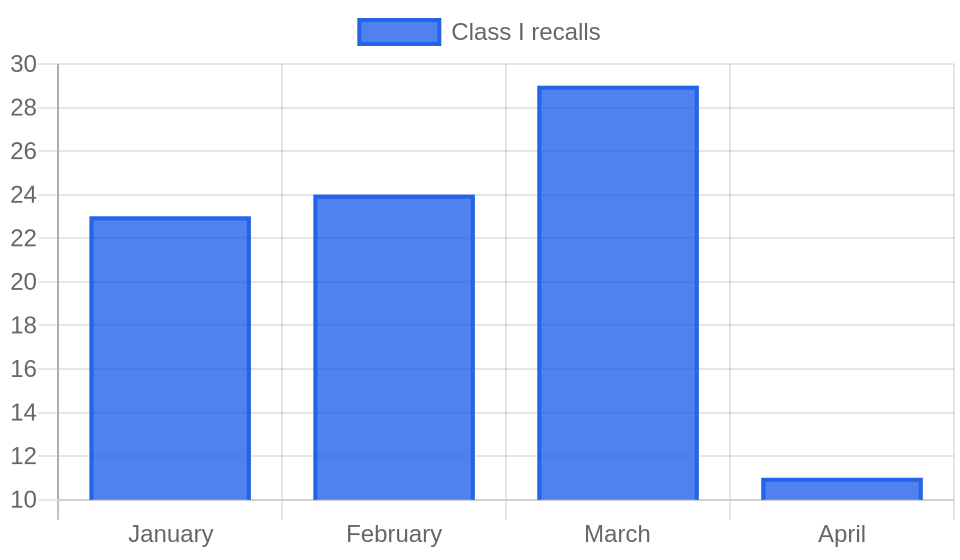
Thirteen Class I recalls in a single week is a lot. For context, FDA posted 11 Class I recalls in all of April. This week matched more than a full month's worth in seven days, and it did so largely because of two ingredient-driven cascades, the California Dairies milk powder and the Raw Farm raw cheddar. When contamination sits in a raw input rather than a finished good, the recall count balloons, because every product that used the input has to come off the shelf on its own record. Watching the monthly trend understates weeks like this one.
What to watch
- July 13, 2026: deadline for manufacturers to submit safety and use data on BHT and ADA, and to comment on FDA's finalized food-chemical post-market program
- June 11, 2026: comments due on FDA's Drug Repurposing for Unmet Medical Needs request for information
- June 10 and June 12, 2026: comment deadlines on two agency information-collection notices
- The California Dairies cascade is not finished. Blackstone Products (Parmesan Ranch Seasoning) and Sugar Foods (Kroger croutons) both issued Salmonella recalls on May 15, and more downstream products are likely as manufacturers reconcile their supplier lots
- The Raw Farm outbreak, and whether this expanded recall finally closes it out or the pathogen surfaces again in a later batch
Policy Canary tracks every FDA action, warning letters, recalls, guidance, and rules, against the specific products you make, by name and by ingredient. See what we would flag for your products.
Get this in your inbox every Friday.
Free FDA intelligence digest. No account required.