Red Dye 3 Ban: FDA Lifted the Stay, and the January 15, 2027 Deadline Never Moved
FDA overruled Micro-Tracers' objections and lifted the stay on its Red No. 3 repeal. Food and supplement makers have until January 15, 2027; ingested drugs until January 18, 2028.
On August 5, FDA published an eight-page notice in the Federal Register (91 FR 50475) that overruled the only objections filed against its repeal of FD&C Red No. 3, denied the request for a hearing, and lifted the administrative stay that had frozen the repeal since February 18, 2025.
What the notice did not change matters more for planning. The effective dates are exactly the ones FDA set in January 2025: January 15, 2027 for food, including dietary supplements, and January 18, 2028 for ingested drugs. As of today, that leaves 157 days for food.
If your team read the stay as a reprieve, it wasn't one. The calendar kept running for the nearly 18 months the order sat frozen.
Why the repeal was frozen
The repeal comes from a January 16, 2025 order (90 FR 4628) granting a 2022 color additive petition from the Center for Science in the Public Interest and others. The legal basis is the Delaney Clause, section 721(b)(5)(B) of the FD&C Act, which deems a color additive unsafe for any ingested use once it has been found to induce cancer in man or animal. Red No. 3 has caused thyroid tumors in male rats.
Objections to a color additive order stay it automatically, and one party objected: Micro-Tracers, Inc., through Buchanan Ingersoll & Rooney, in a submission dated February 18, 2025, the last day of the objection window.
Micro-Tracers' interest had nothing to do with candy. The company makes color-coded tracers for medicated animal feed. According to FDA's notice, its Microtracer F-Red uses Red No. 3 in premixes containing Elanco's Skycis (narasin), and Microtracer FS-Red/Natural Yellow is used in premixes containing Elanco's Rumensin (monensin). When a feed sample is tested, the dyed particles show which drug premix went into it.
Three objections, three rejections
The statistics. Micro-Tracers submitted a Bayesian reanalysis arguing that FDA should not have combined benign adenomas with carcinomas, and that the 4 percent dose group was not meaningfully different from controls. Whether adenomas count under the Delaney Clause is a question of law, and FDA does not grant hearings on questions of law. On the data, it restated its 1990 numbers: combined thyroid tumors in 18 of 68 male rats (26.5 percent) at the 4 percent dose, against 2 of 68 (2.9 percent) in controls, p < 0.0007. The historical-control data Micro-Tracers cited, drawn from more than 3,600 rats, put the background adenoma rate in males at 2.8 percent.
The tracer use. Micro-Tracers argued that the amounts reaching edible tissue are vanishingly small, and that a tracer is not a color additive at all because the color doesn't make feed more appealing. FDA's response is that Delaney leaves it no discretion to weigh low exposures, and that the color is the entire point of the product: it lets a buyer confirm the feed contains Elanco's proprietary drug rather than a generic. That makes it a color additive. Even if it were treated as a food additive, FDA added, the parallel Delaney provision in section 409(c)(3) would apply.
An exemption or a tolerance. The only exemption inside the Delaney Clause is the DES Proviso for animal feed, which requires an approved regulatory method showing no residue in edible tissue. No such method exists for Red No. 3, and Micro-Tracers never applied for one. A tolerance, FDA said, is legally incompatible with a "no residue" standard.
FDA describes the notice as its final action on the objections.
FDA does not say Red No. 3 is dangerous to people
FDA does not claim Red No. 3 harms people at the levels found in food. In the 2025 order, the agency said the rat tumors come from a hormonal mechanism specific to male rats, estimated the highest human exposure at 0.25 mg/kg body weight per day, and calculated a 210-fold margin against the no-effect level for the thyroid effects. FDA's Red No. 3 page says there is no evidence it causes cancer in humans.
The practical upshot is a compliance date. There is no reason to pull product today.
How the cutoff actually works
The mechanism is certification. Under the 2025 order, once 21 CFR 74.303 is removed, certificates for existing batches of Red No. 3 stop being effective for food use and every lot is treated as uncertified. Food made with it after that date is adulterated. Food made with it while the certificate was still effective is not adulterated because of the color. FDA's page says the same thing in consumer terms: Red No. 3 may still appear on products sold after the effective date if they were manufactured before it.
That has consequences you can plan around:
- Your color inventory expires. Red No. 3 still in your warehouse on January 15, 2027 becomes uncertified color you cannot put into food.
- The federal cutoff keys on manufacture date. Finished goods made before it can sell through under federal law.
- California is earlier and stricter. The California Food Safety Act (AB 418, Chapter 328, Statutes of 2023) bars manufacturing, selling, distributing, holding, or offering for sale a food containing red dye 3 starting January 1, 2027, with civil penalties of up to $5,000 for a first violation and $10,000 for each one after. That is a sales ban, so product made in December still can't be sold in California in January.
Imports get no special treatment. FDA's January 2025 constituent update notes that other countries still allow erythrosine but that imported foods must meet U.S. requirements. Cosmetics and externally applied drugs are unaffected; their provisional Red No. 3 listing ended in 1990.
Where Red No. 3 shows up in our data
We searched every recall record in our database from March 2024 through August 11, 2026 (3,473 records) for Red No. 3 under any of its label names. Twelve FDA Enforcement Report entries named it. In eleven of them, Red No. 3 was in the product and missing from the label.
- Walmart's Great Value Cherry Mixed Fruit cups and its peach, mandarin, and cherry variety pack: two Class III entries in October 2024 covering 852,731 units nationwide. Reason: "FD&C Red No 3 was not declared as an ingredient."
- Shoppers Value Fruit Cocktail in heavy syrup, from Shandong Joywin International Trading: 1,105 cases, Class III, July 2025.
- Wise Onion Rings: 490 cases in seven states from New York to Florida, Class II, July 2026, for "undeclared Yellow 5 and 6, Blue 1, and unapproved Red 3."
- Smaller entries for Loard's Ube Ice Cream, The Candy Basket's Marionberry Jelly Sticks, and Gina Marie Bakery cookies, among others.
The twelfth, New Grains Gluten Free Bakery's frosted sugar cookies, was a Class I allergen recall. Its ingredient statement is the instructive part. Red #3 appears twice, once inside the frosting's "Red Dye" blend and once inside the sprinkles.
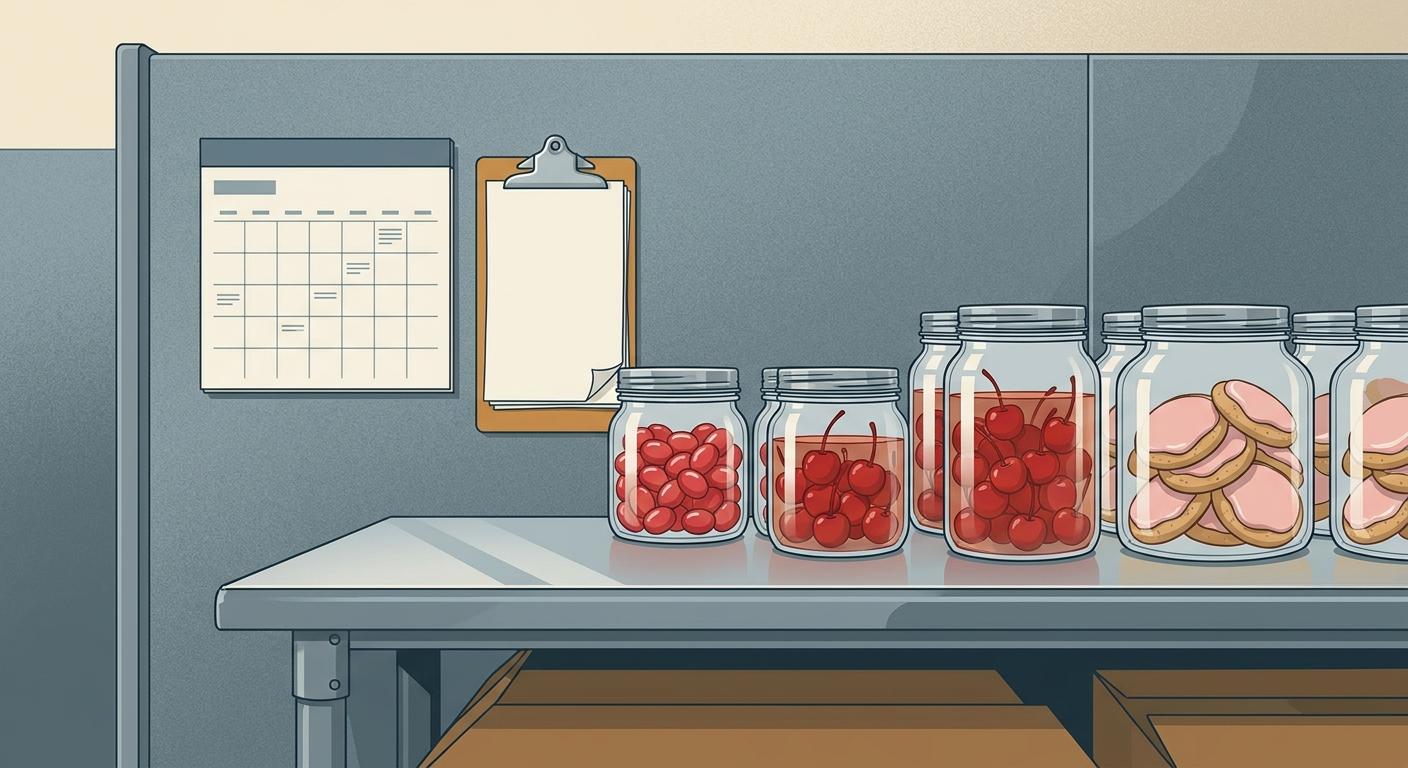
Our reading: cocktail cherries, sprinkles, dye blends, and fruit fillings carry Red No. 3 into products whose brand owners may not know it's there. Your own ingredient statement is the last place to look for it.
What to do before January
- Inventory from supplier specs, not labels. For every colored component you buy (cherries, sprinkles, icings, color blends, candy inclusions, jams, coated pieces), get a written statement on whether it contains FD&C Red No. 3, which may also appear as Red 3, erythrosine, E127, or C.I. 45430.
- Run two calendars if you sell in California. January 1 for anything that will sit on a California shelf, January 15 for production everywhere else.
- Stop reordering Red No. 3 in quantities you can't use up before the cutoff.
- Think before swapping to Red 40. It's the obvious shade match, but FDA's April 2025 announcement asked industry to remove Red 40 and five other synthetic dyes by the end of 2026. That request is voluntary, not a rule, but a Red 40 swap may mean reformulating twice.
- Drug makers have until January 18, 2028. A recolored drug needs stability data, and a change to a product under an approved application has to be reported under 21 CFR 314.70. Seventeen months is not much time for that work.
- Feed manufacturers using red tracers should ask their tracer supplier now which colorant replaces Red No. 3.
If none of your products or components contain Red No. 3, no action is required. You won't know that until step 1 is done.
Sources
- FDA, "Micro-Tracers, Inc.; Response to Objections and Requests for a Public Hearing," 91 FR 50475 (August 5, 2026), Docket FDA-2023-N-0437
- FDA, "Color Additive Petition From Center for Science in the Public Interest, et al.; Request To Revoke Color Additive Listing for Use of FD&C Red No. 3 in Food and Ingested Drugs," 90 FR 4628 (January 16, 2025)
- FDA, FD&C Red No. 3 and HHS, FDA to Phase Out Petroleum-Based Synthetic Dyes (April 22, 2025)
- California AB 418, California Food Safety Act, Chapter 328, Statutes of 2023
- FDA Enforcement Report entries F-1209-2024, F-0032-2025, F-0033-2025, F-0559-2025, F-0560-2025, F-0670-2025, F-0832-2025, H-0259-2025, H-0003-2026, H-0008-2026, H-0754-2026, H-1146-2026
Policy Canary tracks every FDA action, warning letters, recalls, guidance, and rules, against the specific products you make, by name and by ingredient. See what we would flag for your products.
Get this in your inbox every Friday.
Free FDA intelligence digest. No account required.