Jalapeño Salmonella recall: how 53,760 bulk cases became 49 Class I entries
Jalapeños traced to one Sinaloa grower sickened 488 people and led to 49 Class I recall entries from eight firms. What the cascade shows about traceability, FSMA 204 and FSVP.
On October 2, CDC declared the Salmonella Javiana outbreak linked to fresh jalapeños over. The final count on FDA's outbreak page is 488 people sick in 34 states, 65 hospitalized, no deaths. Of the 308 people interviewed, 281 (91%) had eaten at a Mexican-style restaurant, including Chipotle and QDOBA. FDA traced the peppers to a grower in Sinaloa, Mexico, that supplied Coast Citrus Distributors of San Diego.
The last line of FDA's update is the one worth sitting with. Investigators inspected a common Mexican distributor, found no jalapeños left to sample, and collected environmental samples that all came back negative. FDA "was unable to determine a route or source of contamination."
So the investigation never found the contamination. What it found was a supply chain, and most of the public record since is that supply chain recalling itself, one processor at a time.
The upstream recall: a month of product, no lot codes
Coast Citrus began a limited recall on July 22. On August 5, the day FDA and CDC announced the outbreak (345 sick in 27 states at that point), it agreed to recall the rest of the implicated jalapeños. FDA classified it Class I on August 18, and it appeared in the Enforcement Report on August 26 (H-1242-2026):
- 53,760 cases in bulk Coast Tropical cartons of 10 to 40 pounds, product of Mexico.
- Distributed "primarily to wholesale distributors in the central and east coast states," then "further distributed nationwide," in bulk containers "intended for further processing."
- "No retail distribution has been identified as of 08/10/2026."
- Code information: "No lot code information. Recall is for all product with a pack date of 07/01/2026 through 07/31/2026."
That last field is the traceability problem in one line. Without lot codes, the only boundary Coast Citrus could draw was the calendar. Every case packed in July was in scope, and every buyer of a July case had to treat it as suspect.
The restaurants had moved before the outbreak was public: Chipotle switched suppliers for affected stores on July 20, and QDOBA stopped serving jalapeños on July 28, per FDA's August 5 update. The peppers that went to processors were a different story.
Eight firms, 49 Class I entries
By our count, FDA's Enforcement Report carried 49 Class I entries from eight firms for jalapeños or products made with them between August 26 and September 23. Add the five company recall announcements dated August 8 to 12, and that is 54 records in our data for one outbreak by October 6.
| Firm | Class I entries | What was recalled | Quantity listed |
|---|---|---|---|
| Coast Citrus Distributors | 1 | Bulk fresh jalapeños | 53,760 cases |
| Taylor Fresh Foods | 25 | Pico, salsas, guacamole, dips, a burrito, a roast beef sandwich, salad kits | About 224,000 units across the 25 entries |
| WFM Purchasing (Whole Foods) | 10 | Guacamoles, salsas, a Trio Dip | 12,995 units total |
| NatureBest Pre-Cut & Produce | 8 | HEB and NatureBest pico de gallo, stuffed mushrooms, soup mix, diced peppers | 62,856 cases total |
| Ron's Home Style Foods | 2 | 5-lb pico de gallo and salsa | 2,270 lbs total |
| Dairyland Produce (Hardie's Fresh Foods) | 1 | Repacked jalapeños | 7,456 lbs |
| Get Fresh Produce | 1 | 2-lb and 10-lb jalapeño boxes | 802 cases |
| Sirna & Sons Produce | 1 | 1-lb foodservice bags | 249 bags |
Two cautions. Whole Foods and NatureBest each repeat one shared total on every entry, so those are event totals. Taylor's entries each carry their own count, so adding them is fair. And Taylor's entries say only "potential contamination with Salmonella." The link to Coast Citrus comes from Taylor's August 9 announcement, which says it recalled "upon notification that Coast Citrus Distributors is voluntarily recalling fresh jalapeños."
Taylor's list is the clearest picture of how one ingredient spreads. The products went to Hannaford, Kroger, Stop and Shop, Target, Trader Joe's, Walmart and Whole Foods in 26 states. The two largest entries are not salsas: a Spicy Jalapeño Jarlsberg Dip (60,145 units) and a Spicy Pimento Cheese Dip (56,449 units), both sold at Kroger. Nobody shopping for dip thinks of it as a produce recall.
Some exposure ran a tier deeper. Salata Dressings of Houston recalled its Jalapeño Avocado Dressing at HEB after "the company's supplier notified that diced jalapeños used in the affected products may have been contaminated." Coast Citrus sold whole peppers in bulk cartons, so by our reading at least one more processor sat between it and Salata.
The paperwork ran weeks behind the recalls
Company announcements came within days of August 5. The Enforcement Report, the formal record with classifications and quantities, took much longer.
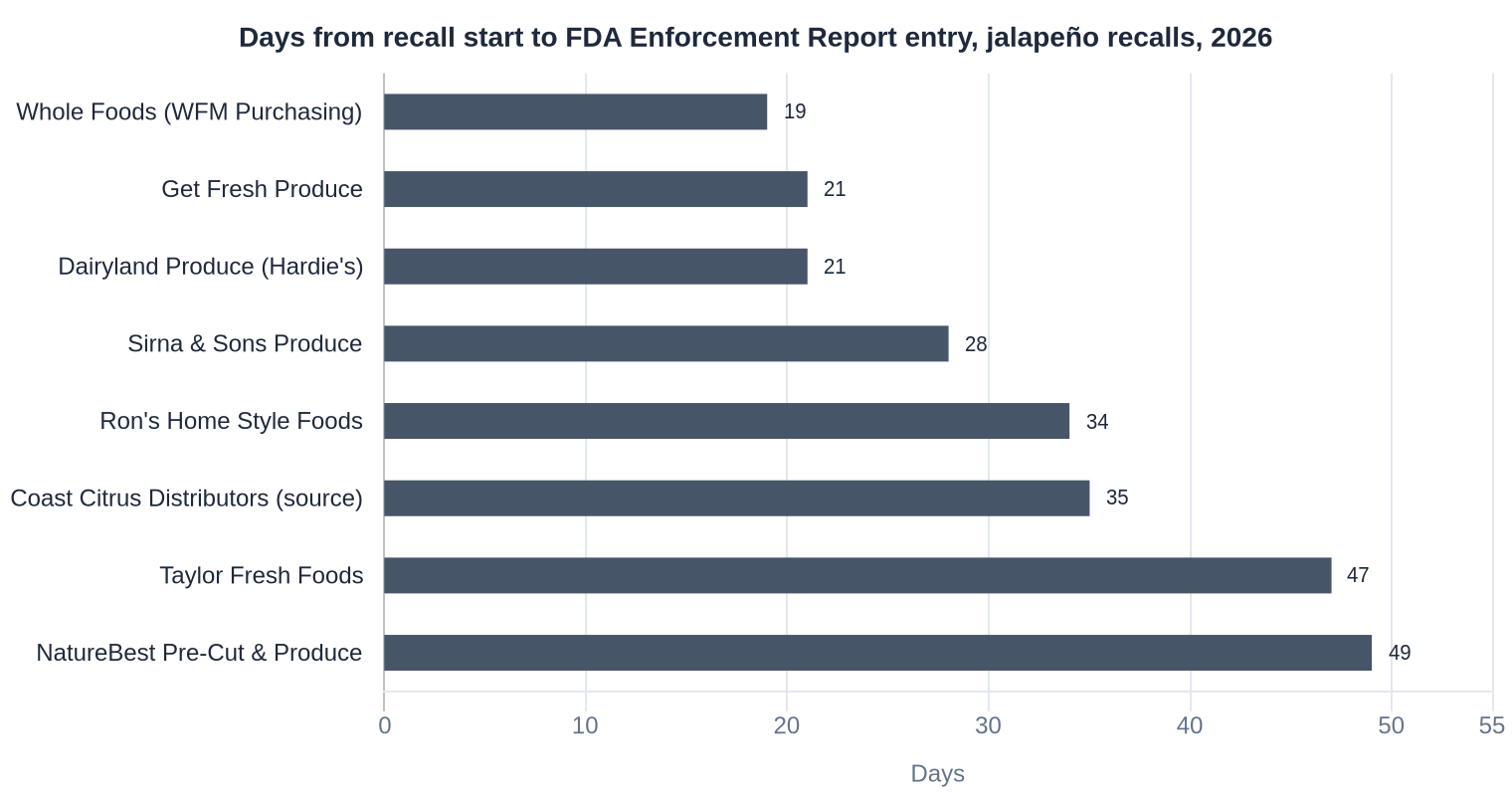
Taylor started its recall on August 7 and reached the report on September 23, 47 days later. NatureBest took 49. FDA's own recall summary page for the outbreak, created August 20, lists five companies and has not been updated since. Get Fresh, Sirna & Sons and Ron's are not on it, so a processor checking only that page would have missed three of the eight firms.
Where FSMA 204 fits, and where it doesn't yet
FDA's Food Traceability Rule (21 CFR Part 1, Subpart S, under Section 204 of the Food Safety Modernization Act) was written for events like this. Fresh peppers are on the Food Traceability List, and so are fresh-cut vegetables. The rule also covers foods that contain a listed food as an ingredient, as long as that ingredient stays in the same fresh form. Pico de gallo with raw jalapeño qualifies. So does most of Taylor's list.
Three pieces of the rule bear on this cascade:
- Traceability lot codes. The initial packer of a raw agricultural commodity must assign one (21 CFR 1.1320). A processor that turns peppers into pico assigns a new code and records which incoming lots went into it (1.1350). A recall bounded by lot code is narrower than "everything packed in July."
- 24-hour production. In an outbreak, covered firms must hand FDA their records within 24 hours, as an electronic sortable spreadsheet (21 CFR 1.1455(c)(3)).
- Foreign firms are covered. FDA says the rule applies to foreign firms producing food for U.S. consumption as well as domestic ones.
Here is the limit. The original compliance date was January 20, 2026. FDA proposed pushing it 30 months to July 20, 2028, and Congress, in a continuing appropriations act for fiscal 2026, directed FDA not to enforce the rule before that date. None of these firms was legally required to keep 204 records this summer. Our reading is that the rule would not have prevented this outbreak, since FDA never found the source. It would most likely have shortened the recall window and the guessing that came with it.
FSVP is the control that applies today
The import-side rule is already enforced. The Foreign Supplier Verification Program (FSVP, 21 CFR Part 1, Subpart L) requires importers to verify that a foreign supplier meets U.S. safety standards, including the Produce Safety Rule for covered produce.
FDA has been citing pepper importers this year. Mesquite Gourmet of San Antonio received an FSVP warning letter dated August 4 and posted September 1 for having no FSVP for fresh Anaheim, habanero and jalapeño peppers. It was Mesquite's third FSVP inspection since 2023, and the firm had asked for six more months to comply. M G R Produce of Houston got a June 2 letter that listed jalapeños among foods imported without an FSVP. Supplier names in both letters are redacted, and nothing in either ties them to this outbreak. They show where FSVP enforcement lands: on the importer of record. By our count FDA posted 62 FSVP warning letters between January 1 and October 6.
What to do this week
If you make anything with fresh jalapeños or other fresh peppers:
- Pull July and August receiving logs and match them against the Coast Tropical UPCs and the July 1 to July 31 pack dates in H-1242-2026. Ask your distributor in writing whether any of your peppers came from Coast Citrus. FDA's advice to firms that can't tell was to work with the supplier until they can.
- Ask each pepper and fresh-cut supplier what lot code it will give you and whether it can trace that code to a grower and pack date. If the answer is "pack date only," your next recall will be bounded by the calendar, as this one was.
- If you import fresh produce yourself, confirm you have a written FSVP for each food and foreign supplier. That requirement is enforceable now, and July 2028 has nothing to do with it.
If you sell finished products made by a co-packer: ask the co-packer for its ingredient suppliers on anything containing fresh produce. Kroger, Target and Trader Joe's shelves carried recalled product because of Taylor's dips and salsas.
If you don't use fresh peppers or fresh-cut vegetables: no action is needed on this outbreak.
Sources
- FDA, Outbreak Investigation of Salmonella: Jalapeño (August 2026), updates of August 5, 10, 13, 14, 19 and 21 and October 2, 2026; CDC outbreak notice updated October 2, 2026
- FDA Enforcement Report, August 26, September 2, September 9 and September 23, 2026: H-1242-2026 (Coast Citrus), H-1246 to H-1255-2026 (WFM Purchasing), H-1256 (Dairyland), H-1257 (Get Fresh), H-1262 (Sirna & Sons), H-1302 and H-1303 (Ron's), H-1344 to H-1368 (Taylor), H-1372 to H-1379 (NatureBest)
- Company announcements: Taylor Fresh Foods, NatureBest, Whole Foods Market, Salata Dressings, Hardie's Fresh Foods (August 8 to 17, 2026); FDA Major Product Recalls page for the outbreak
- FDA warning letters to Mesquite Gourmet LLC (MARCS-CMS 731021, August 4, 2026) and M G R Produce LLC (MARCS-CMS 730040, June 2, 2026)
- FSMA Food Traceability Rule and Food Traceability List; 21 CFR 1.1320 and 1.1455
Policy Canary tracks every FDA action, warning letters, recalls, guidance, and rules, against the specific products you make, by name and by ingredient. See what we would flag for your products.
Get this in your inbox every Friday.
Free FDA intelligence digest. No account required.