FDA's Empower Pharmacy warning letter: why vitamin-added GLP-1s were still "essentially copies"
FDA says Empower Pharmacy's tirzepatide-niacinamide and semaglutide-B12 vials are essentially copies, citing order volume and menu-picked prescriber statements. What to change now.
FDA's September 18 warning letter to Empower Pharmacy turns on one question: who decided the vitamin mattered?
Empower, a Houston compounding pharmacy, made tirzepatide with niacinamide and semaglutide with vitamin B12 (cyanocobalamin). Adding a second ingredient has been a common way for 503A pharmacies to keep compounding GLP-1s after FDA's enforcement discretion for straight copies ended (March 5, 2025 for tirzepatide, April 24, 2025 for semaglutide). The theory is that the blend differs from the approved drugs, and a prescriber has documented why the difference matters for the patient.
FDA's letter (WL 738238, posted September 22) leaves the merits of niacinamide alone. Its argument is that nobody made the determination the law requires, and it builds that case from Empower's own order volume and prescription records.
What the letter says
FDA inspected Empower's 503A pharmacy at 7601 N. Sam Houston Parkway West from November 3 to 14, 2025. The letter names three products:
- Tirzepatide/niacinamide 17/2 mg/mL, 4 mL
- Tirzepatide/niacinamide 8/2 mg/mL, 2.5 mL
- Semaglutide/cyanocobalamin 5/0.5 mg/mL, 1 mL
FDA says they "appear to be essentially copies of FDA-approved semaglutide and tirzepatide products" and that Empower compounded them "regularly and in inordinate amounts." The letter gives a monthly order count for each product from July through October 2025, and every one of the twelve figures is redacted under (b)(4). We don't know the volumes and won't estimate them.
FDA lists its evidence. First, orders "that lack any prescriber determination of significant difference." Second, purported determinations "that appear to be repeated verbatim across many records, suggesting that they may be pre-generated for selection by the prescriber, rather than written by the prescriber for an identified individual patient." Third, volume.
Then comes the sentence that will be read most closely outside the pharmacy:
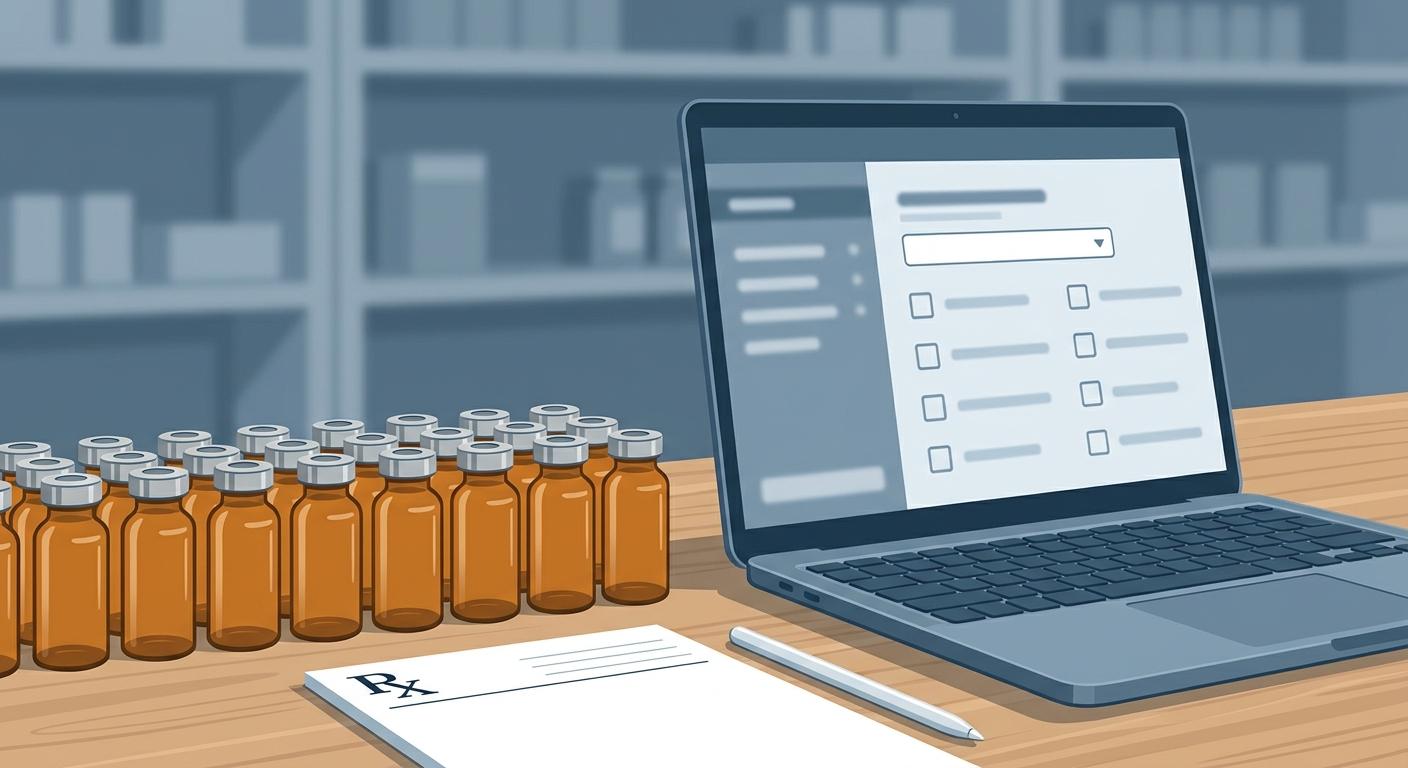
"Generating prescriptions through means that undermine the individualized nature of a prescriber's clinical judgment (for example through third-party technology platforms that provide prescribers with pre-selected menu options for choosing a statement of significant difference) call the individualized nature of those determinations into question..."
And on volume: "The volume of products you are producing suggests that differences between products you are compounding and the FDA-approved products are pretextual."
Once the products fall outside 503A, the rest follows. They become unapproved new drugs under section 505(a), misbranded under 502(f)(1) for lacking adequate directions for use, and subject to full drug CGMP.
Old policy, new workflow
The legal framework isn't new. FDA's January 2018 guidance, Compounded Drug Products That Are Essentially Copies of a Commercially Available Drug Product Under Section 503A, already says:
- A prescription that names only the patient and the formulation is not enough. Its examples of a sufficient note are short and specific, such as "No Dye X, patient allergy."
- A lower price is not a significant difference.
- One sign of compounding copies "regularly or in inordinate amounts" is a compounder that "offers pre-printed prescription pads" a prescriber can use without making the determination.
- As policy, FDA does not plan to act on copies when a compounder fills four or fewer prescriptions for the product in a calendar month.
The guidance also quotes the 1997 conference report: where "the 'significant difference' is a mere pretext," the compounding counts as copying.
Our reading: the 2026 letter treats the telehealth dropdown as the modern pre-printed prescription pad. The 2018 guidance says FDA "generally does not intend to question prescriber determinations that are documented," and the letter doesn't question any prescriber's medical judgment. It questions whether a determination happened at all when the same sentence shows up verbatim across many records. That argument is narrow, and it is hard to rebut by producing the prescriptions, because the prescriptions are the evidence.
How rare this charge is
We searched the 1,762 distinct warning letters posted from January 2024 through September 29, 2026 in our database. Empower's is the only one containing "inordinate amounts," "pretextual" or "pre-selected menu." Twenty-eight letters in that period discuss section 503A. The nearest GLP-1 case, Boothwyn Pharmacy's January 2026 letter (posted February 10), cited a tirzepatide/glycine/methylcobalamin injection for being released after it failed sterility testing, not for being a copy.
So this is a first. One letter shows what FDA is prepared to argue, and says nothing about how many more are coming.
Empower's fourth FDA letter
| Letter date | Entity | Site | Main findings |
|---|---|---|---|
| Oct 15, 2021 | Empower Pharmacy (503B outsourcing facility) | 5980 W. Sam Houston Pkwy N. | 503B labeling and reporting conditions |
| Apr 2, 2025 | Empower Pharma (503B) | 5980 W. Sam Houston Pkwy N. | 503B labeling, insanitary conditions |
| Apr 2, 2025 | Empower Pharmacy (503A) | 7601 N. Sam Houston Pkwy W. | Insanitary conditions |
| Sep 18, 2026 | Empower Pharmacy (503A) | 7601 N. Sam Houston Pkwy W. | Essentially copies, insanitary conditions, CGMP |
By our count of FDA's posted letters, this is the fourth to an Empower Clinic Services entity and the second to this 503A site.
The sterile findings repeat. The April 2025 letter said Empower's "media fills were not performed under the most challenging or stressful conditions." The 2026 letter says it again, word for word. It also finds Empower's fixes unproven. A smoke study run March 30 to April 3, 2026 was still "in controlled post-execution review" and had not been provided to FDA. A January 2026 media fill summary reported no contamination, but FDA says the summary "does not appear to match the number of vials inspected" in the underlying records, some entries were marked "N/A" with no definition, and results were transcribed onto a different form revision without a clear audit trail. The vial counts are redacted.
Empower has 15 working days to respond. The letter closes with the standard warning that FDA may take action, including seizure and injunction, without further notice.
What to change
If you run a 503A pharmacy filling vitamin-added GLP-1s:
- Pull a month of prescriptions for each blend and count the distinct significant-difference statements. If one sentence covers most of them, you have the pattern FDA cited.
- Check that each statement gives a patient-specific reason the added ingredient matters. A generic line about B12, repeated on every script, is not that.
- Know your monthly fills for each product without a documented difference against the guidance's four-prescription line.
If you run a 503B outsourcing facility: the essentially-copies charge here is a 503A provision. Your GLP-1 exposure runs through FDA's April 30 proposal to exclude semaglutide, tirzepatide and liraglutide from the 503B bulks list. Comments closed June 29, and we have not seen a final decision.
If you sell only FDA-approved GLP-1 products: no action is needed.
Sources
- FDA Warning Letter to Empower Clinic Services, LLC dba Empower Pharmacy, WL 738238, September 18, 2026
- Earlier letters: MARCS-CMS 613792 (October 15, 2021), 700962 and 700964 (April 2, 2025), FDA Warning Letters database
- FDA guidance, Compounded Drug Products That Are Essentially Copies of a Commercially Available Drug Product Under Section 503A (January 2018)
- FD&C Act sections 503A(b)(1)(D), 503A(b)(2), 505(a), 502(f)(1), 501(a)(2)(A) and (B)
Policy Canary tracks every FDA action, warning letters, recalls, guidance, and rules, against the specific products you make, by name and by ingredient. See what we would flag for your products.
Get this in your inbox every Friday.
Free FDA intelligence digest. No account required.